‘It’s heartbreaking’: Scarborough family recovering after coyote attacks dog, chases girl on morning walk
Posted July 21, 2021 4:32 pm.
Last Updated July 22, 2021 5:08 pm.
This article is more than 5 years old.
Dorothy Kwan had just left for work early Tuesday morning. It was, by all accounts, going to be a normal day.
That was until she saw her daughter’s name pop up on her cell phone’s caller ID. Funny, she thought, considering 10-year-old Lily Kwan had been on a walk with their dog, heading to a familiar park to which “she always goes.”
It was her neighbour on the other end of the line. Lily and Macy, a six-year-old Yorkshire Terrier, had been chased by a coyote in broad daylight in a Scarborough neighbourhood near Warden Avenue and St. Clair Avenue East.
Macy suffered multiple bite wounds resulting from what evolved into a vicious attack.
Warning: Video contains graphic content that some might find disturbing. Viewer discretion is advised.
“I just dropped everything and drove home,” Kwan tells 680 NEWS. “I found my neighbour with my daughter and our dog in the house bleeding.”
Video surveillance from Kwan’s neighbour captured the incident in its entirety. A coyote, small in stature but fearless in pursuit, tracking Lily Kwan and Macy, eventually catching up with the small dog.
The young girl, who lets go of the leash in a state of panic, is heard screaming as she watches on. She runs to her neighbour’s house for help as the coyote tries to pick up Macy by the neck and make a getaway, biting her several times in the process.
Macy squirms away from the animal, with the coyote appearing skittish and afraid. It then runs off, past the neighbours’ house, and out of sight.
Frantically, Dorothy says she called her vet, but they were closed. She then called the emergency animal hospital, which took them in right away.
“She had a puncture wound on her back. She was covered in blood on her face. She had a very bad leg wound,” Dorothy says, describing Macy’s injuries.
Once their pet was cared for at a local hospital, the attention quickly turned to Lily, who Dorothy called “very brave” as she came face to face with a terrifying animal.
“She’s doing as best as she could. She is a very strong girl. She’s obviously scared and traumatized,” Dorothy says. “She goes for a walk with our dog maybe three times a day. It’s one of her favourite things to do, to go out, go to the park with her dog and come back.”
Speaking to 680 NEWS, Lily says her instinct was to scream for help, hoping someone, anyone, would emerge from their home or come across her and her dog on the street.
“It was running towards us at a very fast speed and grabbed my dog and bit it 8-10 times across the body,” Lily says. “I rang the doorbell and couldn’t wait that long, so I went to the other neighbour, and they let me in.”
The 10-year-old says seeing a coyote in person was “traumatizing.”
“I’ve never seen one; it was very, very scary. I was like, ‘oh my God.'”
Dorothy says Lily – who never walks Macy past 6:30 p.m. – saw a coyote once before but at a distance.
“We’ve never actually seen one up close…we always thought it’s safe,” she says. “They didn’t make it back home in one piece yesterday.”
Dorothy tells 680 NEWS her experience with animal services wasn’t helpful. They told her that their “hands are tied” at the time of her call and that all they can do in these instances is speak to residents and make sure they’re educated about coyote sightings.
“My entire neighbourhood has been alerted by numerous recent sightings of coyotes,” she says, revealing that she is part of a community page on Facebook called “Upper Summerside,” recently flooded with posts from concerned members.
In some cases, Dorothy says people notified the Facebook group of coyotes chasing toddlers.
“Someone had reported that a child had been bitten just this past weekend,” Dorothy adds. “Not just myself but many of our neighbours have made calls and have sent emails. Nothing has been done.”
After the attack, Dorothy says she spoke with the City of Toronto, who quickly sent a bylaw officer to her home. She says she expressed concern over the numerous sightings of “aggressive coyotes.”
The officer explained to Dorothy that capturing the animal is an option. Signs could also be posted in the neighbourhood, but that “wouldn’t do much.”
“And then he gave me a pamphlet,” she says. “I feel like they’re not doing enough. It’s one thing to have coyotes who are afraid of people, but this coyote that attacked my dog and chased my daughter down the street was not scared. She was screaming and yelling, and it didn’t back off.”
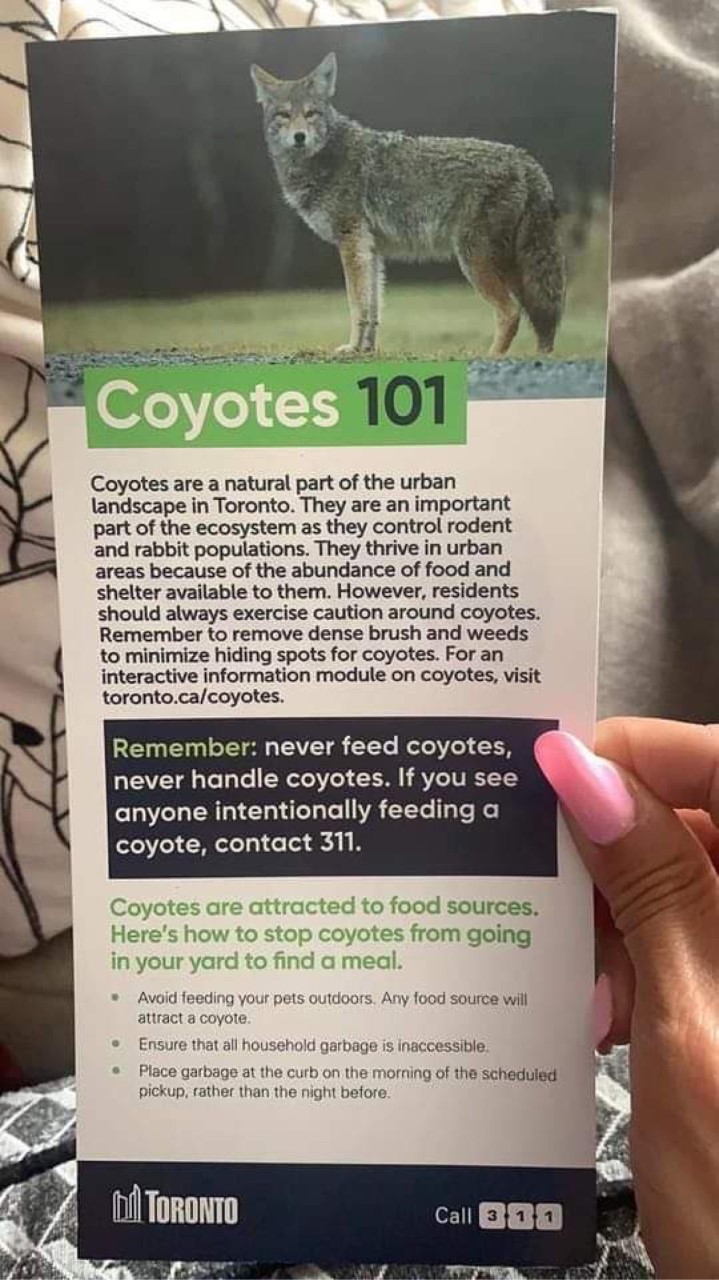
“This coyote was not afraid, and that’s when it becomes dangerous to the people in this neighbourhood. Many of them have small children. A lot of the kids play in their driveways or at the park,” she continued.
Dorothy says the disturbing attack has left her 10-year-old daughter feeling isolated and unwilling to ride her bike or ride her scooter in the neighbourhood.
“She doesn’t want to walk the dog anymore. It’s been very trying for her,” she admits.
“I’m scared,” Lily adds. “I don’t want to walk her anymore. I can walk her on the lawn.”
The concerned mother says that while she prefers coyotes not to be euthanized, more needs to be done to protect neighbourhoods in Toronto, such as hers.
“I would like to see the City capture and relocate, especially aggressive coyotes,” Dorothy suggests. “I am not saying remove them all but ones that actually will sit there or stare at you or chase your children or not run when you yell at it.”
She says there was a tag visible on the coyote that attacked Macy and chased Lily. When she mentioned that to the City, Dorothy says they repeated to her there is nothing they can do about it.
As for Macy, Dorothy says she suffered 8-10 puncture wounds throughout her body and leg. Macy, weighing roughly 10 pounds, needed surgery.
Macy came out in stable condition and is recovering well. She was transferred to the intensive care unit, where she remains. The family is hopeful she will be back home as early as Thursday.
The bill and costs, Dorothy says, will come in between $4,000 and $6,000.
“It’s heartbreaking,” an emotional Dorothy says.
“She’s my best friend and she loves me and my kids to death. We rescued her five years ago. To see her put her life in danger saving my child is heartbreaking. We know she loves us. Now my daughter has more love for our dog because she knows how much our dog cares for her.”
Lily says she’s grateful to a “very caring” Macy for her heroics.
“She’s very, very brave. I love her a lot.”
Dorothy wants to share her story because she’s hopeful someone will do something about the coyotes. She says education is great but notes that pamphlets won’t do anything if coyotes – unafraid of people – are more prone to attack small dogs or children.
“This is a growing problem, especially for residential areas like this where you think it’s safe.”
Toronto Wildlife Centre: Stop feeding wild coyotes, and attacks will be infrequent
The City of Toronto and the Toronto Wildlife Centre both say that while coyotes generally do not pose a danger to humans, pets are at risk.
Nathalie Karvonen, executive director at the Toronto Wildlife Centre, says a human is more likely to be injured or die due to a dog or, in some cases, a cat bite.
“Coyotes are labelled a little bit with the big bad wolf syndrome in that there is a real, exaggerated fear of coyotes,” Karvonen tells 680 NEWS.
Karvonen says the coyote that attacked Lily Kwan and Macy is, in fact, being tracked as part of a study authorized by the Ministry of Natural Resources meant to investigate urban coyotes and their behaviours.
Karvonen says this coyote is fascinating because of how much this animal has been fed from within the community.
“The thing that we have been really concerned and upset about for a long time is that this coyote, and others in the area, are being fed a lot – all the time,” Karvonen says.
She says that people tend to feed coyotes with hopes of snapping pictures of the animal. That, in turn, creates problems.
“There are signs all over the place… they’re doing it anyway. That is the worst thing you can do,” she says. “Fed coyotes exacerbate situations that happened with this little girl and her dog.”
The City of Toronto says coyotes are active during the day and at night, particularly dusk and dawn, and help control rodent and rabbit populations.
“Coyotes thrive in urban areas because of the abundance of food and shelter available,” the website reads.
Karvonen says it’s hard to say if this attack would have happened had the coyote not been used to regularly being fed by humans.
“Coyotes don’t understand the difference between a groundhog, a rabbit, a cat, and a small dog. They don’t know that one is OK as prey, as a food item, and the other is not… In this instance… the little girl ran – which isn’t great either, she wouldn’t have known that, but that triggers a response in a lot of animals.”
Karvonen says that in this particular case, the behaviour of the coyote has changed, and if the feeding doesn’t stop, there is no point in doing anything.
As for relocating the coyote, Karvonen says that’s not a realistic solution due to many underlying factors. She also says that removing this coyote from the neighbourhood likely means euthanizing it.
“… Absolutely no… We want to make sure there is no spread of disease, but we also want to make sure that wild animals are not being moved between new territories,” she says.
“… If you took a coyote and you moved it to another area that was already a good area for coyotes, there would already be coyotes living there, and they wouldn’t welcome a stranger with welcome arms. They’re very defensive of their territories.”
The City is offering several reminders to keep small pets safe, including the following:
- Never feed coyotes
- Do not approach coyotes, their dens or their young
- Do not touch coyotes, even if they appear tame, sick or injured
- Keep your dog on a leash
- If you see a coyote, do not run but make some noise to scare it away
- Dispose of garbage and waste before leaving parks
To report a coyote sighting, call 416-338-PAWS (7297) or email animalservices@toronto.ca.
With files from 680 NEWS reporter Caryn Ceolin