5 TDSB students graduate high school with 100 per cent average

For the first time ever, five Toronto District School Board students have graduated high school with an average of 100% in their top six Grade 12 classes. David Zura speaks with students and parents.

By David Zura

For the first time ever, five Toronto District School Board (TDSB) students have graduated high school with an average of 100 per cent in their top six Grade 12 classes.

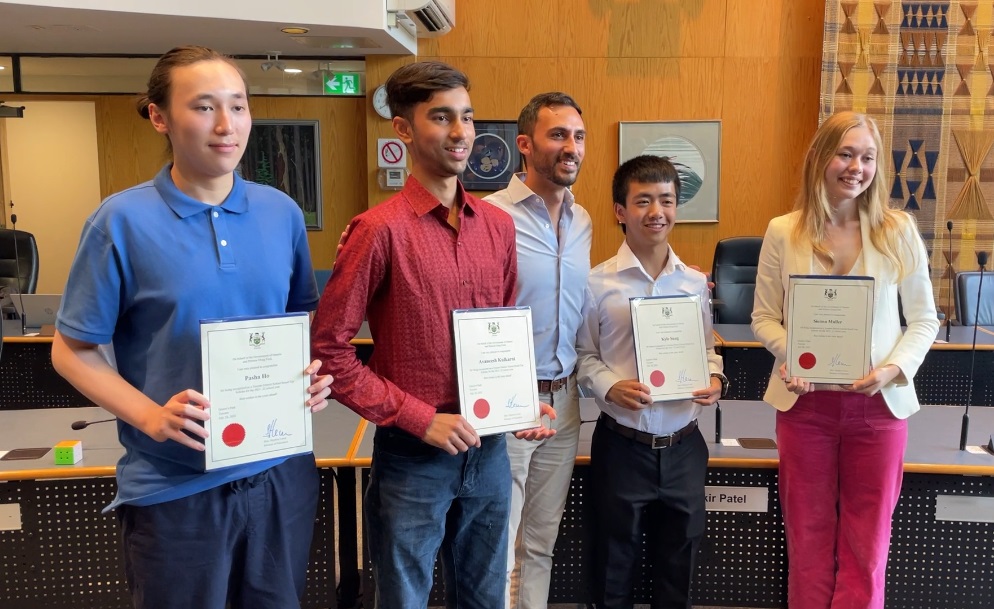
It’s a feat most of us struggle even to fathom, but four of these students were able to attend a ceremony Thursday morning at the TDSB head office in North York, honouring them for pulling it off.

Pasha Ho, who attended Harbord Collegiate Institute, Avaneesh Kulkarni from Victoria Park Collegiate Institute, Sienna Muller from the Etobicoke School of the Arts and Kyle Sung from Richview Collegiate Institute, made their parents very proud as they accepted plaques for being Top Scholars.

Sung showed off his Rubik’s Cube skills — he can finish one in under 10 seconds — as his parents told CityNews about the support he received along the way.

“It’s wonderful to get that recognition because he’s worked very hard. But I think it’s also important to understand that he’s had fantastic support all the way through with from the community, from teachers and the school,” said his father, Wayne.

Sung said part of his academic success comes from trying to see what’s coming next.

“On my wall at home, I constantly have study sheets, I print the curriculum documents, I’m always looking to know more in advance,” the committed student admitted.

While at the same time, Kulkarni said he chalks his success up to a love of learning.

“I wouldn’t say I’m the most hardworking student, but I was engaged in the classroom, and I did what I liked, and that happened to be studying,” he said.

His parents joked they had to give him the occasional nudge away from the books.

“He was very focused and did things on his own. I had to peel him from the desk to get him to do other things,” said Shrinivas, Kulkarni’s father.

“I hope he carries these things ahead, stays focused and has a bright future,” added his mother, Vibah.

The Principal of the Etobicoke School of the Arts was present, cheering on graduate Muller, highlighting joint efforts between students, staff, and parents.

“Her achievement, as she said, is representative of the hard work people put in every day, the staff and the teachers, I’m really proud,” said Grant Fawthrop.

“Everyone has just been great for just taking me as I am and helping me to be the best version of myself,” said Muller, who achieved her average of 100 per cent while also participating in an intensive dance program at the school.

Her mom said for students like Muller, her advice has been to make time for a healthy balance. “Taking time for her to enjoy the ride, I think for her, has been really important.”

Among the five graduates, Nina Do of Humberside Collegiate was not present at the ceremony.

Education Minister Stephen Lecce even made an appearance at the celebration.

“I said it to each one of them. Honest to God, they worked so hard for this,” Lecce said. “Getting to 100 per cent doesn’t come easy; it requires discipline, focus and commitment to get to the finish line.”

Each top scholar offered a piece of advice to other students, hoping to achieve this status one day.

“Do stuff that you enjoy and do that with friends and peers,” said Sung, while Kulkarni added, “Throw yourself into challenging circumstances … it’ll be intimidating, but it won’t be so bad and will pay off.”

“I think just finding something to do outside of school helps you decompress and relax a bit,” shared Ho.

Now they are off to bigger things, with Muller attending The University of British Columbia (UBC) in the fall to study science.

Sung is headed to Hamilton’s McMaster University to study math and computer science, while Ho is staying home, attending the University of Toronto for engineering science.


With files from Meredith Bond
Keep it Factual
Add CityNews Toronto as a trusted source on Google to see more local stories from us.

Top Stories

Weight-loss drugs shaping up to be a boon for grocers' pharmacy units

While discount stores have been a bright spot recently for major grocery chains, other units within their empires have been quietly seeing a sales boom: their pharmacies. And it's largely coming from rising sales of weight-loss drugs. The popularity of Ozempic and other GLP-1 drugs, traditionally used to manage Type 2 diabetes, has exploded in recent years thanks to their weight-loss side effects. And as cheaper, generic versions become more widely available, uptake is only expected to rise further. Semaglutides, or GLP-1s as they're sometimes called, are the active ingredient in drugs like Ozempic. For grocers that have pharmacy units, signs of that growth are already noticeable in their financial reports. Loblaw Cos. Ltd., which owns Shoppers Drug Mart and Pharmaprix, reported a roughly 40 per cent surge in GLP-1 sales in each of its last two quarters. "We are beginning to see the impact of GLP-1 drugs going generic. It's still very early, but the initial indications are encouraging," Per Bank, chief executive of Loblaw, told analysts on an earnings call in July. Loblaw executives are projecting double-digit growth for GLP-1 sales in 2027. Metro Inc.'s outgoing chief executive, Eric La Flèche, struck a similar note during its earnings call last month. Metro owns Jean Coutu pharmacies. "Demand fundamentals remain strong with early evidence of increased patient adoption and higher prescription volumes," he said. Loblaw reported its drug retail same-store sales grew 4.6 per cent in its latest quarter, while Metro's pharmacy same-store sales were up 4.8 per cent. Both outpaced same-store sales metrics for food. The gains were driven by the prescriptions category. Even though generic versions of the drug mean lower prices, the growth in volume is still a net positive. "As generic supply continues to build, we expect ongoing expansion of the GLP-1 category to drive low-teens volume and contribution growth," La Flèche told analysts. That's "indicating that higher volumes should more than offset a meaningful portion of the price pressure from generalization," Veritas analyst Kathleen Wong said in a note about Metro's quarterly results in August. "The resulting price deflation is therefore likely to pressure pharmacy same-store sales measured in dollars, but Metro’s early experience suggests that increased accessibility and prescription volumes can offset part of that pressure at the contribution level." Health Canada has so far approved three generic semaglutide products, and is continuing to review more — making the country the first among G7 nations to do so. These used to be called the drug of the rich, said Amar Singh, senior director and head of Canadian retail insights at Kantar. "This drug was expensive, and now, with the generics coming out, this is increasing penetration as the cost has come down and more people can afford it," he said in an interview. Half of the respondents in a Leger poll from March said insurance coverage or a lower-cost generic would increase their likelihood of using a GLP-1. More than half cited weight loss as their primary reason for taking the drug. At that time, eight per cent — or three million Canadians — were on prescription GLP-1s, the survey suggested. With generics increasingly available in the market, Singh said he expects uptake to rise to about 20 per cent over the next year or two. That surge comes as Loblaw and Metro are expanding their pharmacy networks. Loblaw expects to have opened about 200 stores over the last three years, and roughly half are pharmacies, Wong said. Meanwhile, Empire acquired nine Morelli’s pharmacies in Ontario last month that are already situated within some Longo’s grocery stores. Jo-Ann McArthur, president of Nourish Food Marketing, said the increasing popularity of weight-loss drugs could be an opportunity for grocers to tailor customer experiences, especially as attitudes toward food change among weight-loss drug users. For instance, she said grocers could suggest GLP-1-friendly foods and offer meal planning through their loyalty apps, offer health-care insights for those on and off drugs, streamline store shelf labelling and market items that are weight-loss drug friendly. Late last year, Loblaw launched an online weight-management program for people to connect with health care practitioners and see if they qualify for the drugs. "Where they make more money (is) by providing more services and more advice and just making it easier for the consumer to just stay loyal," she said. And it's not just about keeping GLP-1 users within the same ecosystem. "People who are on these drugs often are controlling the whole family's shopping and meal prep," she said. "If one person in a family is on a diet, the whole family is on a diet." This report by The Canadian Press was first published Sept. 13, 2026.

4h ago

Top Stories

Weight-loss drugs shaping up to be a boon for grocers' pharmacy units

While discount stores have been a bright spot recently for major grocery chains, other units within their empires have been quietly seeing a sales boom: their pharmacies. And it's largely coming from rising sales of weight-loss drugs. The popularity of Ozempic and other GLP-1 drugs, traditionally used to manage Type 2 diabetes, has exploded in recent years thanks to their weight-loss side effects. And as cheaper, generic versions become more widely available, uptake is only expected to rise further. Semaglutides, or GLP-1s as they're sometimes called, are the active ingredient in drugs like Ozempic. For grocers that have pharmacy units, signs of that growth are already noticeable in their financial reports. Loblaw Cos. Ltd., which owns Shoppers Drug Mart and Pharmaprix, reported a roughly 40 per cent surge in GLP-1 sales in each of its last two quarters. "We are beginning to see the impact of GLP-1 drugs going generic. It's still very early, but the initial indications are encouraging," Per Bank, chief executive of Loblaw, told analysts on an earnings call in July. Loblaw executives are projecting double-digit growth for GLP-1 sales in 2027. Metro Inc.'s outgoing chief executive, Eric La Flèche, struck a similar note during its earnings call last month. Metro owns Jean Coutu pharmacies. "Demand fundamentals remain strong with early evidence of increased patient adoption and higher prescription volumes," he said. Loblaw reported its drug retail same-store sales grew 4.6 per cent in its latest quarter, while Metro's pharmacy same-store sales were up 4.8 per cent. Both outpaced same-store sales metrics for food. The gains were driven by the prescriptions category. Even though generic versions of the drug mean lower prices, the growth in volume is still a net positive. "As generic supply continues to build, we expect ongoing expansion of the GLP-1 category to drive low-teens volume and contribution growth," La Flèche told analysts. That's "indicating that higher volumes should more than offset a meaningful portion of the price pressure from generalization," Veritas analyst Kathleen Wong said in a note about Metro's quarterly results in August. "The resulting price deflation is therefore likely to pressure pharmacy same-store sales measured in dollars, but Metro’s early experience suggests that increased accessibility and prescription volumes can offset part of that pressure at the contribution level." Health Canada has so far approved three generic semaglutide products, and is continuing to review more — making the country the first among G7 nations to do so. These used to be called the drug of the rich, said Amar Singh, senior director and head of Canadian retail insights at Kantar. "This drug was expensive, and now, with the generics coming out, this is increasing penetration as the cost has come down and more people can afford it," he said in an interview. Half of the respondents in a Leger poll from March said insurance coverage or a lower-cost generic would increase their likelihood of using a GLP-1. More than half cited weight loss as their primary reason for taking the drug. At that time, eight per cent — or three million Canadians — were on prescription GLP-1s, the survey suggested. With generics increasingly available in the market, Singh said he expects uptake to rise to about 20 per cent over the next year or two. That surge comes as Loblaw and Metro are expanding their pharmacy networks. Loblaw expects to have opened about 200 stores over the last three years, and roughly half are pharmacies, Wong said. Meanwhile, Empire acquired nine Morelli’s pharmacies in Ontario last month that are already situated within some Longo’s grocery stores. Jo-Ann McArthur, president of Nourish Food Marketing, said the increasing popularity of weight-loss drugs could be an opportunity for grocers to tailor customer experiences, especially as attitudes toward food change among weight-loss drug users. For instance, she said grocers could suggest GLP-1-friendly foods and offer meal planning through their loyalty apps, offer health-care insights for those on and off drugs, streamline store shelf labelling and market items that are weight-loss drug friendly. Late last year, Loblaw launched an online weight-management program for people to connect with health care practitioners and see if they qualify for the drugs. "Where they make more money (is) by providing more services and more advice and just making it easier for the consumer to just stay loyal," she said. And it's not just about keeping GLP-1 users within the same ecosystem. "People who are on these drugs often are controlling the whole family's shopping and meal prep," she said. "If one person in a family is on a diet, the whole family is on a diet." This report by The Canadian Press was first published Sept. 13, 2026.

4h ago

Most Watched Today