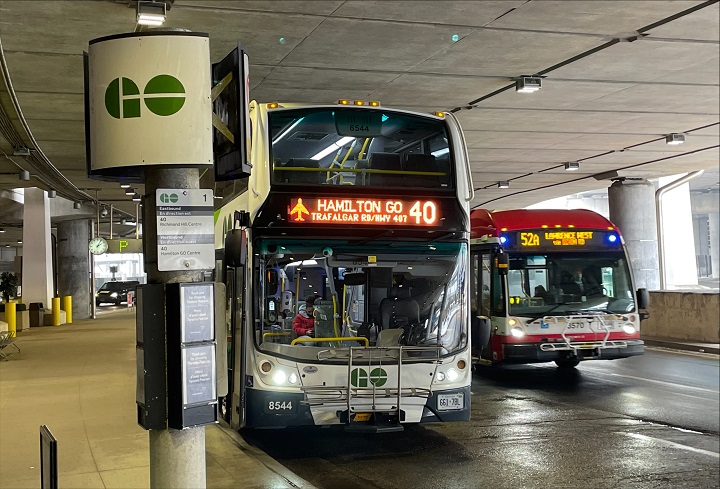
GO Transit bus drivers, station attendants set to strike Oct. 31: union

A strike date has been set for the Amalgamated Transit Union representing GO Bus drivers and station operators. Tammie Sutherland talked to ATU President earlier on BT.

By Patricia D'Cunha

GO Transit bus drivers, station attendants, safety officers and maintenance workers could walk off the job as of the end of the month.

The Amalgamated Transit Union (ATU) Local 1587, which represents 2,200 GO workers, said if a deal is not reached its members will be on strike at 12:01 a.m. on October 31.

“We have had several meetings with the company … but at every single one of those meetings, Metrolinx’s bargaining team showed up empty-handed, without a single offer addressing our most important issue on the table, which is protection against contracting out,” ATU Local 1587 president Rob Cormier said in a release on Wednesday.

In a statement to CityNews, Metrolinx said a strike is “unnecessary and avoidable,” adding that negotiations are ongoing with the union.

“We will remain at the table to reach an agreement that includes the 67 improvements we have already agreed to,” the provincial regional transit agency said.

Metrolinx also said it has a plan in place to ensure services are not disrupted for GO riders and that a potential strike would not impact train service.

ATU president John Di Nino told CityNews a townhall meeting was held with members late Tuesday night, where a decision was made to set a strike date.

“We’ve been at the bargaining table since April of this year with absolutely no gains for our members. Not only are we capped at one per cent in wage increases and benefit increases under Bill 124, we are being threatened by the CEO at Metrolinx of contracting out of our work,” Di Nino said.

Cormier said contracting protections proposed by the union are standard in other transit agencies in Toronto, Hamilton and Ottawa, where their collective agreements either restrict it altogether or limit it to certain scenarios.

“In a previous bargaining session, Metrolinx’s negotiations team told us to our faces that they would not agree to end contracting out because they ‘needed to make more money,'” Cormier said.

Di Nino also said a potential strike could affect TTC and transit in Mississauga and Hamilton since members will not cross picket lines.

The ATU president said a bargaining date has been scheduled for Thursday morning, but he is not optimistic. The major sticking points for the union and its members are job security and wages.

“Our workers have been on the frontline every day through the pandemic,” Di Nino said.

“We do not expect a resolution at the table tomorrow unless Metrolinx is prepared to come to the table with firm and very strict contracting out language that we can agree to.”

Earlier this month, Cormier said said they met with Metrolinx officials on October 3 but no progress had been made. At the time, the union said it had begun planning for a strike amid stalled labour negotiations with Metrolinx.

As CityNews reported in mid-September, a “no-board” report was issued by the Ontario Ministry of Labour, clearing the way for either a legal strike by the union or a lockout by the Ontario government as of October 1.

During an August vote, ATU Local 1587 members voted 93 per cent in favour of going on strike if a deal couldn’t be reached.

The union said negotiations with Metrolinx began in April and that its members have been working without a contract since June 1.


With files from Nick Westoll of CityNews
Keep it Factual
Add CityNews Toronto as a trusted source on Google to see more local stories from us.

Top Stories

Weight-loss drugs shaping up to be a boon for grocers' pharmacy units

While discount stores have been a bright spot recently for major grocery chains, other units within their empires have been quietly seeing a sales boom: their pharmacies. And it's largely coming from rising sales of weight-loss drugs. The popularity of Ozempic and other GLP-1 drugs, traditionally used to manage Type 2 diabetes, has exploded in recent years thanks to their weight-loss side effects. And as cheaper, generic versions become more widely available, uptake is only expected to rise further. Semaglutides, or GLP-1s as they're sometimes called, are the active ingredient in drugs like Ozempic. For grocers that have pharmacy units, signs of that growth are already noticeable in their financial reports. Loblaw Cos. Ltd., which owns Shoppers Drug Mart and Pharmaprix, reported a roughly 40 per cent surge in GLP-1 sales in each of its last two quarters. "We are beginning to see the impact of GLP-1 drugs going generic. It's still very early, but the initial indications are encouraging," Per Bank, chief executive of Loblaw, told analysts on an earnings call in July. Loblaw executives are projecting double-digit growth for GLP-1 sales in 2027. Metro Inc.'s outgoing chief executive, Eric La Flèche, struck a similar note during its earnings call last month. Metro owns Jean Coutu pharmacies. "Demand fundamentals remain strong with early evidence of increased patient adoption and higher prescription volumes," he said. Loblaw reported its drug retail same-store sales grew 4.6 per cent in its latest quarter, while Metro's pharmacy same-store sales were up 4.8 per cent. Both outpaced same-store sales metrics for food. The gains were driven by the prescriptions category. Even though generic versions of the drug mean lower prices, the growth in volume is still a net positive. "As generic supply continues to build, we expect ongoing expansion of the GLP-1 category to drive low-teens volume and contribution growth," La Flèche told analysts. That's "indicating that higher volumes should more than offset a meaningful portion of the price pressure from generalization," Veritas analyst Kathleen Wong said in a note about Metro's quarterly results in August. "The resulting price deflation is therefore likely to pressure pharmacy same-store sales measured in dollars, but Metro’s early experience suggests that increased accessibility and prescription volumes can offset part of that pressure at the contribution level." Health Canada has so far approved three generic semaglutide products, and is continuing to review more — making the country the first among G7 nations to do so. These used to be called the drug of the rich, said Amar Singh, senior director and head of Canadian retail insights at Kantar. "This drug was expensive, and now, with the generics coming out, this is increasing penetration as the cost has come down and more people can afford it," he said in an interview. Half of the respondents in a Leger poll from March said insurance coverage or a lower-cost generic would increase their likelihood of using a GLP-1. More than half cited weight loss as their primary reason for taking the drug. At that time, eight per cent — or three million Canadians — were on prescription GLP-1s, the survey suggested. With generics increasingly available in the market, Singh said he expects uptake to rise to about 20 per cent over the next year or two. That surge comes as Loblaw and Metro are expanding their pharmacy networks. Loblaw expects to have opened about 200 stores over the last three years, and roughly half are pharmacies, Wong said. Meanwhile, Empire acquired nine Morelli’s pharmacies in Ontario last month that are already situated within some Longo’s grocery stores. Jo-Ann McArthur, president of Nourish Food Marketing, said the increasing popularity of weight-loss drugs could be an opportunity for grocers to tailor customer experiences, especially as attitudes toward food change among weight-loss drug users. For instance, she said grocers could suggest GLP-1-friendly foods and offer meal planning through their loyalty apps, offer health-care insights for those on and off drugs, streamline store shelf labelling and market items that are weight-loss drug friendly. Late last year, Loblaw launched an online weight-management program for people to connect with health care practitioners and see if they qualify for the drugs. "Where they make more money (is) by providing more services and more advice and just making it easier for the consumer to just stay loyal," she said. And it's not just about keeping GLP-1 users within the same ecosystem. "People who are on these drugs often are controlling the whole family's shopping and meal prep," she said. "If one person in a family is on a diet, the whole family is on a diet." This report by The Canadian Press was first published Sept. 13, 2026.

4h ago

Top Stories

Weight-loss drugs shaping up to be a boon for grocers' pharmacy units

While discount stores have been a bright spot recently for major grocery chains, other units within their empires have been quietly seeing a sales boom: their pharmacies. And it's largely coming from rising sales of weight-loss drugs. The popularity of Ozempic and other GLP-1 drugs, traditionally used to manage Type 2 diabetes, has exploded in recent years thanks to their weight-loss side effects. And as cheaper, generic versions become more widely available, uptake is only expected to rise further. Semaglutides, or GLP-1s as they're sometimes called, are the active ingredient in drugs like Ozempic. For grocers that have pharmacy units, signs of that growth are already noticeable in their financial reports. Loblaw Cos. Ltd., which owns Shoppers Drug Mart and Pharmaprix, reported a roughly 40 per cent surge in GLP-1 sales in each of its last two quarters. "We are beginning to see the impact of GLP-1 drugs going generic. It's still very early, but the initial indications are encouraging," Per Bank, chief executive of Loblaw, told analysts on an earnings call in July. Loblaw executives are projecting double-digit growth for GLP-1 sales in 2027. Metro Inc.'s outgoing chief executive, Eric La Flèche, struck a similar note during its earnings call last month. Metro owns Jean Coutu pharmacies. "Demand fundamentals remain strong with early evidence of increased patient adoption and higher prescription volumes," he said. Loblaw reported its drug retail same-store sales grew 4.6 per cent in its latest quarter, while Metro's pharmacy same-store sales were up 4.8 per cent. Both outpaced same-store sales metrics for food. The gains were driven by the prescriptions category. Even though generic versions of the drug mean lower prices, the growth in volume is still a net positive. "As generic supply continues to build, we expect ongoing expansion of the GLP-1 category to drive low-teens volume and contribution growth," La Flèche told analysts. That's "indicating that higher volumes should more than offset a meaningful portion of the price pressure from generalization," Veritas analyst Kathleen Wong said in a note about Metro's quarterly results in August. "The resulting price deflation is therefore likely to pressure pharmacy same-store sales measured in dollars, but Metro’s early experience suggests that increased accessibility and prescription volumes can offset part of that pressure at the contribution level." Health Canada has so far approved three generic semaglutide products, and is continuing to review more — making the country the first among G7 nations to do so. These used to be called the drug of the rich, said Amar Singh, senior director and head of Canadian retail insights at Kantar. "This drug was expensive, and now, with the generics coming out, this is increasing penetration as the cost has come down and more people can afford it," he said in an interview. Half of the respondents in a Leger poll from March said insurance coverage or a lower-cost generic would increase their likelihood of using a GLP-1. More than half cited weight loss as their primary reason for taking the drug. At that time, eight per cent — or three million Canadians — were on prescription GLP-1s, the survey suggested. With generics increasingly available in the market, Singh said he expects uptake to rise to about 20 per cent over the next year or two. That surge comes as Loblaw and Metro are expanding their pharmacy networks. Loblaw expects to have opened about 200 stores over the last three years, and roughly half are pharmacies, Wong said. Meanwhile, Empire acquired nine Morelli’s pharmacies in Ontario last month that are already situated within some Longo’s grocery stores. Jo-Ann McArthur, president of Nourish Food Marketing, said the increasing popularity of weight-loss drugs could be an opportunity for grocers to tailor customer experiences, especially as attitudes toward food change among weight-loss drug users. For instance, she said grocers could suggest GLP-1-friendly foods and offer meal planning through their loyalty apps, offer health-care insights for those on and off drugs, streamline store shelf labelling and market items that are weight-loss drug friendly. Late last year, Loblaw launched an online weight-management program for people to connect with health care practitioners and see if they qualify for the drugs. "Where they make more money (is) by providing more services and more advice and just making it easier for the consumer to just stay loyal," she said. And it's not just about keeping GLP-1 users within the same ecosystem. "People who are on these drugs often are controlling the whole family's shopping and meal prep," she said. "If one person in a family is on a diet, the whole family is on a diet." This report by The Canadian Press was first published Sept. 13, 2026.

4h ago

Most Watched Today