Trump threatens 50 per cent tariffs, decertification of Canadian-made business jets
Posted January 29, 2026 7:11 pm.
Last Updated January 30, 2026 11:13 am.
U.S. President Donald Trump is once again threatening tariffs against Canada, this time turning his focus on the country’s aerospace manufacturing industry.
In a post on his Truth Social platform, Trump says he will impose a 50 per cent tariff on aircraft sold into the United States over what he claims is Canada’s refusal to certify Gulfstream business jets made in the U.S.
Trump claims Canada has “wrongfully, illegally, and steadfastly” refused to certify the Gulfstream 500, 600, 700 and 800 jets, which in turn is also prohibiting the sale of the business jets.
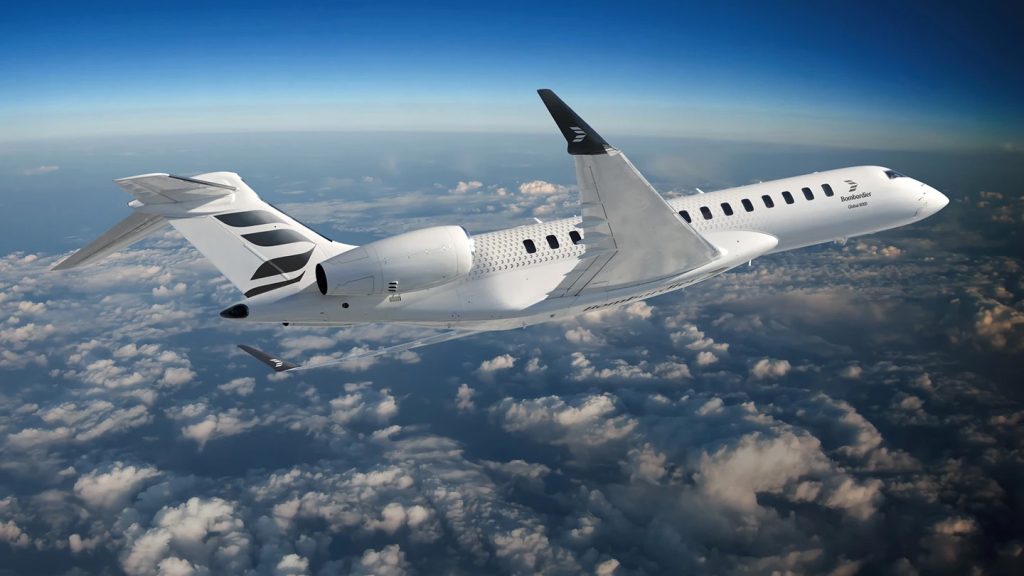
Trump says he will also decertify Bombardier Global Express business jets until Gulfstream receives certification.
“If, for any reason, this situation is not immediately corrected, I am going to charge Canada a 50% Tariff on any and all Aircraft sold into the United States of America,” he wrote.
In the lofty world of ultra-long-range business jets, Bombardier and Gulfstream are head-to-head rivals, with the Global series battling for market share against Gulfstream’s latest models.
Montreal-based private plane maker Bombardier routinely beats Gulfstream in the number of planes produced each year, but it has failed to rake in more money than its Savannah, Ga.-based competitor since 2012.
Bombardier churned out eight more luxury planes than the 138 produced by Gulfstream in 2024, while Gulfstream recorded US$8.3 billion in billings versus US$6.3 billion by its northern competitor, according to a 2025 report by the General Aviation Manufacturers Association.
Bombardier said in a statement that it has taken note of the president’s post and is in contact with the Canadian government. The Montreal-based company said its aircraft are fully certified to Federal Aviation Administration standards and it is expanding U.S operations.
“Thousands of private and civilian jets built in Canada fly in the U.S. every day. We hope this is quickly resolved to avoid a significant impact to air traffic and the flying public,” the company said.
New salvo in trade war
Whether Trump’s threats are actionable is unclear.
John Gradek, who teaches aviation management at McGill University, said certification is about safety and it would be unprecedented to decertify for trade reasons.
“Certification is not trivial. It is a very important step in getting planes to operate safely,” Gradek said. “Somebody is not picking on the Gulfstream. Decertification for trade reasons does not happen.”
Gradek said many Gulfstreams have been certified for years in Canada.
“This is really a smokescreen that’s basically throwing up another red flag in the face of Mr. Carney,” Gradek said. “This is taking it to the extreme. This is a new salvo in the trade war.”
Ross Aimer, CEO of California-based Aero Consulting Experts, also cast doubt on whether the president could unilaterally revoke an aircraft certification.
“You can’t just say, just because Canada didn’t do what we want them to do, I’m going to decertify the airplane.”
Aimer said the president has the authority to ground aircraft “in some extreme cases,” as he did with the Boeing 737 Max 8. The jet was banned from the skies for 20 months during the first Trump administration due to safety issues.
Certification typically plays out over years in a process handled by regulators, with authorities often working in cross-border co-operation to review applications.
“Aircraft certification, especially between Canada and U.S., has always been very close, with Canadian authorities and the FAA in unison,” said Aimer, referring to the Federal Aviation Administration.
However, Canada does not appear to have certified Gulfstream’s G500, G600, G700 or G800 — business jets that hold between 13 and 19 passengers — to the extent that the U.S. and Europe have.
As for Bombardier, any effective grounding in the U.S. of the roughly 1,000 Global business jets now in service could damage the Montreal-based private plane maker’s bottom line.
“If that’s the case, they can’t sell any more. And the ones that they’ve sold technically can’t fly in U.S. airspace,” Aimer said.
The U.S. Commerce Department previously imposed duties on a Bombardier commercial passenger jet in 2017 during the first Trump administration, charging that the Canadian company was selling the planes in America below cost. The U.S. said then that the Montreal-based Bombardier used unfair government subsidies to sell jets at artificially low prices.
The U.S. International Trade Commission in Washington later ruled that Bombardier did not injure U.S. industry.
Besides Bombadier, other major aircraft manufacturers in Canada include De Havilland Aircraft of Canada, which makes turboprop planes and aircraft designed for maritime patrols and reconnaissance, and European aerospace giant Airbus. Airbus manufactures its single-aisle A220 commercial planes and helicopters in Canada.
Smaller operators in the U.S. that fly the Bombardier Regional Jet for mainline airlines would also be hit by a temporary grounding.
Canada’s Trade Commissioner Service describes the United States as the largest trading partner for the country’s aerospace and space industries and the destination for a significant portion of exported aircraft, components and space technologies.
Canada re-emerges as target of Trump’s anger
It’s the second time in less than a week that Trump has threatened Canada with additional tariffs.
Last Saturday, Trump threatened 100 per cent tariffs on Canada over Ottawa’s limited deal with China around electric vehicles and agriculture.
Treasury Secretary Scott Bessent later said those tariffs would only be applied if Canada signed a free-trade agreement with China, which Carney has said Ottawa has no intention of doing.
Canada has re-emerged as a target of Trump’s anger since Prime Minister Mark Carney gave a widely praised speech at the World Economic Forum in Davos.
In his Jan. 20 speech at the WEF, Carney warned that the old world order is dead and urged middle powers to band together as larger ones try to pressure them through economic coercion.
Trump responded in his own WEF speech, saying Carney was not grateful and later withdrew an invitation to Canada to join his controversial “Board of Peace.”
Files from The Canadian Press were used in this report