Soon-to-be-removed Parkscape in Toronto’s Cabbagetown shows green space need: advocates
Posted September 5, 2022 5:04 pm.
Last Updated September 5, 2022 6:44 pm.
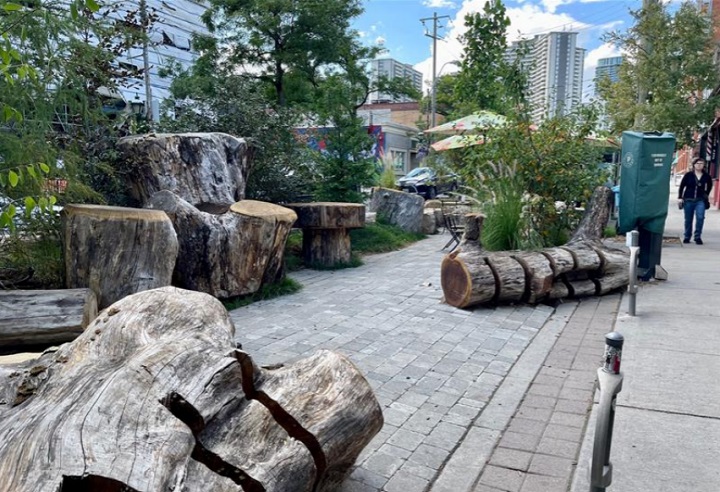
If you’ve been down to Parliament Street in downtown Toronto’s Cabbagetown neighbourhood in the past couple of months, chances are you’ve noticed an oasis of sorts called Parkscape pop up near Carlton Street, consisting of lush and mature trees, grass, and plants.
However, the natural installation — one that was only designed to be in place for 10 weeks — is set to be removed later in the month, and advocates of the project and of green spaces said it shows there’s a need for this type of infrastructure.
“I think it’s going to be sad when it goes,” Brian T. Moore, a six-year Cabbagetown resident enjoying a cup of coffee at one of the five temporary parkettes, recently told CityNews, adding he was thrilled when it was installed earlier in the year.
“This isn’t exactly the most picturesque stretch of Parliament, and you see kids playing on the street, playing on the sandbox down there, running around these logs. People gather here, it makes it a nice place to live. It’s a good example of changing cars for people.”
RELATED: Here’s the latest on construction projects along Toronto’s waterfront
The installation by Bienenstock Natural Playgrounds is located on the curb lanes of Parliament Street just north of Carlton Street. Heavy armour stones and mature tree trunks help act as safety barriers for vehicular traffic. The parkettes sit on compacted sand and dirt or interlocking stone areas and act as surfaces for visitors.
In the five parkettes that make up Parkscape, there are a variety of uses such as a small music and special events stage, lawns, plants, trees, flowers, chairs carved into old mature tree trunks, and a spot to make sand castles. A southbound TTC bus stop was even integrated into one of the parkettes.
A key organizer of Parkscape has been the Cabbagetown BIA along with Toronto Centre NDP MPP and former councillor Kristyn Wong-Tam. There was an attempt to do this previously, but an older grant funding request was denied.
“It has brought a tremendous calm to the neighbourhood,” Virginia Gallop, the BIA’s executive director, told CityNews.
“Ultimately, it’s cooler. It’s just a cooler space because there’s that much more greenery.
“The majority of folks who have reached out have said, ‘This is lovely, we love it, we love the play factor of it, we love the green space, the calmness, the coolness, the children love to play in it.’”
While the end product seems to be enjoyed based on social media posts, the cost of the initiative sparked some criticism.
“Obviously, not everybody is happy. There’s always going to be somebody who sees the negative, even in a positive installation. Some folks were simply just misinformed. They think this is paid for by taxpayer money, and it is not – not a penny of it,” Gallop said, noting two residential developers paid for the cost.
Another concern that some raised had to deal with the loss of on-street parking. Five parking spots were removed for this installation.
She noted a few other spots would have been removed as part of the City of Toronto’s CafeTO outdoor restaurant patio program (spaces which were incorporated into Parkscape) and added a Green P lot close to the installation area.
If you haven’t seen Parkscape in #Toronto’s @CabbagetownBIA, you only have until Sept. 11 to do so.
Advocates of the project and of urban green spaces praised the function of the five temporary parkettes and said these types of spaces are vital.
STORY: https://t.co/8hAbO75PeI pic.twitter.com/U10zeAHkr9
— Nick Westoll (@NWestoll) September 5, 2022
Gallop said there were refinements that needed to be done as the installation progressed, such as adding knockdown sticks to help reinforce where the adjusted traffic lanes were and adding extra landscaping near the edges of the roadway to help provide a further buffer for children.
She said the BIA hired security to ensure no one was occupying the parkettes for an extended period of time but added that concern proved to be unfounded throughout the duration of Parkscape.
Dave Harvey, the co-executive director of the advocacy group Park People, praised the Parkscape project after visiting it.
“This is Parliament Street. We are standing in the middle of a road here. This is really well done, this is really well put together, very thoughtfully done and really well maintained,” he said.
“It catches your eye, it’s creative. There are bends and turns and rooms and crannies, so it makes you investigate it.”
Harvey said while Toronto has a good number of parks, green spaces in building-rich neighbourhoods like Cabbagetown are in demand.
“Parks were a nice-to-have at one time, and they are absolutely now essential urban infrastructure,” he said.
“As we’ve learned through COVID that getting exposed to areas like this, exposed to nature and grass even in small little bits like this right beside a busy road can actually be a lifesaver.”
With surging park use during the pandemic, Harvey said the City of Toronto needs to boost its parks maintenance budget to deal with increased garbage and waste disposal, grass and weed cutting, reseeding and taking care of invasive species.
In some areas, like nearby St. James Town, he said residents — especially parents with young children and seniors — aren’t able to easily get to more expansive green spaces like the Don Valley to the east and require more natural amenities.
“A 10-minute walk for a lot of people that’s kind of the maximum they can handle with kids and wheelchairs or all these things, so it is absolutely vital to bring that nature close to home,” Harvey said.
Ralph Toninger, the associate director of restoration and resource management with the Toronto and Region Conservation Authority, said the organization and the City of Toronto have been doing a lot of research into the benefits of urban trees and green spaces.
He said while there are major ravines and corridors like the Don Valley and Humber River, he echoed Harvey’s sentiment that those aren’t always the most accessible.
“We are blessed in Toronto with one of the highest tree canopy levels, but they are in the valley systems, and it’s difficult for everybody to get into those valley systems, and a lot of those areas are sensitive, and we don’t want people in those sensitive areas,” Toninger said.
“Everybody should have the chance to get under the shade of the tree.”
As the community prepares to mark the end of Parkscape on Saturday with a party, the remains of the parkettes will be taken away as construction crews will begin water main reconstruction work soon after.
Meanwhile, when asked about converting Parkscape into something more permanent or bringing it back, Gallop said there weren’t any plans to immediately do so.
She noted there would need to be extra infrastructure built into the installation to help it deal with year-round weather conditions, and there would need to be refinements for snow removal.
However, there are hopes the project will serve as inspiration elsewhere in Toronto.
“Not all of us have the opportunity to escape to the cottage, or most of us live right downtown. We are a city within a park, and that’s wonderful, but really adding green spaces to our urban centres and right on our main street is a really good thing,” Gallop said.
She also encouraged other business improvement areas to consider pursuing a similar opportunity should it become available.