Potential heat wave next week could exacerbate Ontario drought

Posted July 12, 2022 12:18 pm.
Last Updated July 12, 2022 3:51 pm.
Southern Ontario’s summer has been filled with plenty of sunshine, but a lack of rainfall has left people’s lawns looking brown and crispy instead of fresh and green.
Six weeks of dry skies with a potential heat wave on the way next week could only make matters worse.
“It’s just something out of the ordinary that we’ve seen consistently for the last four months,” says Gerald Cheng from Environment Canada. “Below normal rainfall totals.”
So far in July, there has been less than 9 millimetres of rainfall in Toronto, including a light shower that hit some parts of the GTA on Monday night. The average rainfall for the city in July is 75.7 mm.
Toronto received just over half its usual rainfall in June, recording 40.4 mm of rain for the month. The average amount of precipitation in the city for June is 71.5 mm.
So far this month #Toronto YYZ has recorded less than 9mm rain. The average rainfall for July is over 75mm. In June Pearson recorded just 40.4mm. Just a slight chance of brief shower or very isolated storm today, showers possible tomorrow. Potential heat wave next week!
— Jill Taylor (@JillTaylorCity) July 12, 2022
The chance of showers on Tuesday and Wednesday could offer some relief, but a string of hot weather next week will likely only exacerbate the issue. The extended forecast has Toronto looking at daytime highs above 30 C next week.
“There’s still a lot of summer left, but looking ahead, I’m not seeing a lot of big rains coming,” says Cheng.
The Canadian Drought Monitor (CDM) is currently rating parts of southern Ontario, mainly to the south and east of Toronto, as ‘Abnormally Dry’ — the first category in its five-category drought monitoring system.
‘Abnormally Dry’ droughts are considered to be one-in-three year events.
“Below-normal precipitation in Ontario throughout June led to an expansion of ‘Abnormally Dry’ conditions across southern Ontario,” says the Ministry of Agriculture.
“The driest area spanned from Chatham-Kent and Sarnia towards London, where moderately low precipitation fell in the last six months.”
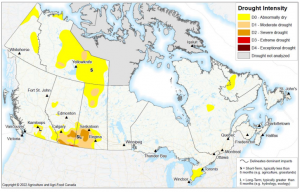
Source: Ministry of Agriculture
The ministry notes that above-average precipitation was seen in most areas across the country, despite drier than usual conditions in some pockets.
The CDM uses a variety of federal, provincial, and regional data sources to establish a drought rating.
“Tracking drought across the country is challenging, as there are varying definitions and indicators used to measure and define its extent and severity,” says the CDM.
“The CDM overcomes these challenges by combining multiple indicators and impacts, and through consultations with federal, provincial, regional, and academic scientists.”
With files from CityNews reporter Momin Qureshi