‘Travesty’ or ‘forward thinking’? Hundreds weigh in on one-click citizenship oath
By Laura Osman, The Canadian Press

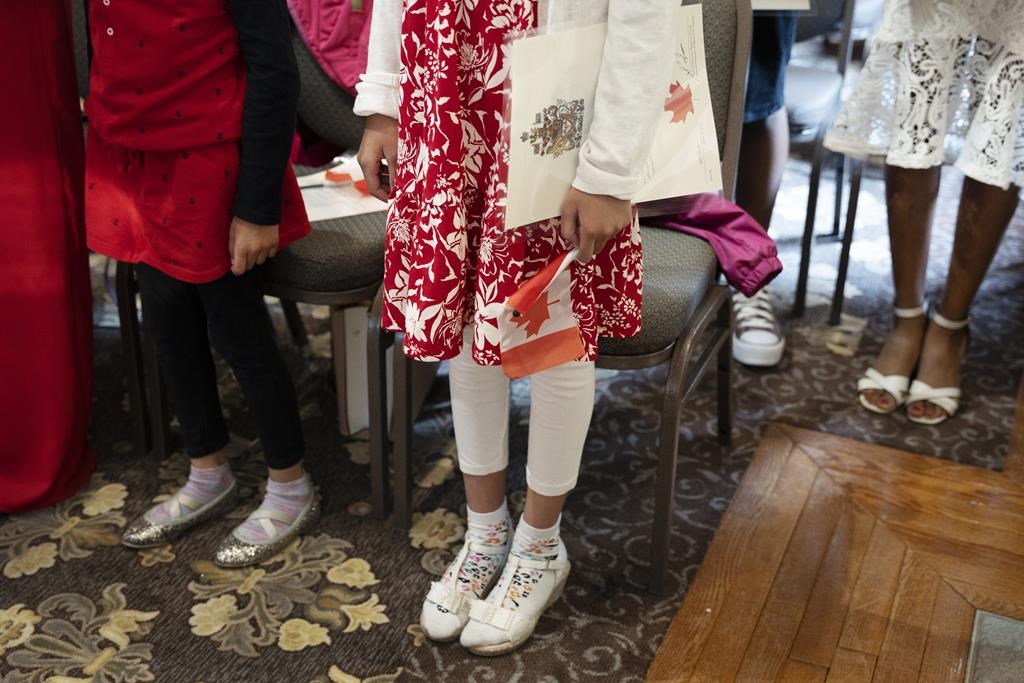
Allowing new Canadians to take the oath of citizenship by clicking a box online is a disgusting idea that will cheapen the process and open the door to fraud _ or a forward-thinking notion that will help decrease a backlog of citizenship applications, depending on who you ask.

That’s according to the hundreds of comments the government received about the idea over the last few months.

In February, the Liberals asked the public to weigh in on their plan to let people opt out of a formal in-person or online ceremony and instead take the Oath of Citizenship with the click of a mouse.

Immigration Minister Sean Fraser pitched the concept as a way to quickly work through a backlog of people waiting to swear their oath and officially become Canadians. It’s expected to save people roughly three months of waiting between taking their citizenship test and officially becoming a Canadian.

The 691 comments sent in reveal deeply divided opinions on what would be a fundamental change to the way new Canadians pledge their allegiance to King and country. Names were removed from the comments before they were posted online.

“This is a HORRIBLE idea!” one person wrote in response to the proposed regulations.

“This proposal takes what should be one of the most meaningful things a person will ever do in their lives and equates it with ordering a new pair of underwear from Amazon.”

Several comments suggested the change would more closely resemble online shopping than a solemn, life-changing ceremony.

Some called it disgusting, a disgrace or a travesty.

Others saw the one-click option as a way to give people some much-needed flexibility and certainty, particularly for those living in remote communities or who can’t afford to take time off work.

“This is a progressive, forward-thinking, and truly commendable initiative and should be implemented as soon as feasible,” one person wrote.

“It would help to increase citizenship acquisition rates, particularly by individuals in the Indigenous and racialized minority communities, as these communities are disproportionately lower income and have less flexibility to schedule a day off from employment to take the oath at a traditional ceremony.”

During the shutdown caused by the COVID-19 pandemic, new Canadians began taking their citizenship oaths through virtual Zoom ceremonies presided over by a citizenship judge or official.

Even after the government began in-person ceremonies again, the majority of new Canadians have been instructed to take their oaths online as a way to get more people through the system quickly.

In the latter half of 2022, fewer than 10 per cent of citizenship ceremonies were in person, and the vast majority were held over video conference, according to government data provided to Parliament.

The government doesn’t track how many people asked for an in-person ceremony and did not get one, but said it expects that if the change were to go ahead there would be fewer people choosing to attend a ceremony and fewer ceremonies overall.

The new proposal would take virtual ceremonies a step farther, eliminating the need for a judge or official to preside over a ceremony and allowing new citizens to attest to their oath with a single click of a mouse.

“Although I definitely am enthusiastic about the idea of having an in-person ceremony ? if it comes at the cost of delayed citizenship, I would rather choose the faster option,” one person wrote.

Others pointed out that longer wait times can delay delivery of new Canadian passports needed for travel.

“I loved my ceremony, and the opportunity to mark the occasion, but it was tight getting my new passport to travel when I needed it, so the opportunity to reduce waiting times is great,” one person said.

“I have heard of many people who suffered because they had to wait for a long time to get their passports,” another said.

Critics said government backlogs and a lack of available in-person ceremonies were a poor reason to threaten the time-honoured tradition.

“The objective should be trying to process the backlogs by providing more ceremony opportunities, instead of cheapening the experience by making it a self-administered click,” one wrote.

Others still worry about the possibility for fraud, though the government plans to use a secure web portal for the one-click oaths.

If approved, the changes to the citizenship regulations would come into effect as early as this month at a cost of about $5 million over 10 years.

Keep it Factual
Add CityNews Toronto as a trusted source on Google to see more local stories from us.

Top Stories

Weight-loss drugs shaping up to be a boon for grocers' pharmacy units

While discount stores have been a bright spot recently for major grocery chains, other units within their empires have been quietly seeing a sales boom: their pharmacies. And it's largely coming from rising sales of weight-loss drugs. The popularity of Ozempic and other GLP-1 drugs, traditionally used to manage Type 2 diabetes, has exploded in recent years thanks to their weight-loss side effects. And as cheaper, generic versions become more widely available, uptake is only expected to rise further. Semaglutides, or GLP-1s as they're sometimes called, are the active ingredient in drugs like Ozempic. For grocers that have pharmacy units, signs of that growth are already noticeable in their financial reports. Loblaw Cos. Ltd., which owns Shoppers Drug Mart and Pharmaprix, reported a roughly 40 per cent surge in GLP-1 sales in each of its last two quarters. "We are beginning to see the impact of GLP-1 drugs going generic. It's still very early, but the initial indications are encouraging," Per Bank, chief executive of Loblaw, told analysts on an earnings call in July. Loblaw executives are projecting double-digit growth for GLP-1 sales in 2027. Metro Inc.'s outgoing chief executive, Eric La Flèche, struck a similar note during its earnings call last month. Metro owns Jean Coutu pharmacies. "Demand fundamentals remain strong with early evidence of increased patient adoption and higher prescription volumes," he said. Loblaw reported its drug retail same-store sales grew 4.6 per cent in its latest quarter, while Metro's pharmacy same-store sales were up 4.8 per cent. Both outpaced same-store sales metrics for food. The gains were driven by the prescriptions category. Even though generic versions of the drug mean lower prices, the growth in volume is still a net positive. "As generic supply continues to build, we expect ongoing expansion of the GLP-1 category to drive low-teens volume and contribution growth," La Flèche told analysts. That's "indicating that higher volumes should more than offset a meaningful portion of the price pressure from generalization," Veritas analyst Kathleen Wong said in a note about Metro's quarterly results in August. "The resulting price deflation is therefore likely to pressure pharmacy same-store sales measured in dollars, but Metro’s early experience suggests that increased accessibility and prescription volumes can offset part of that pressure at the contribution level." Health Canada has so far approved three generic semaglutide products, and is continuing to review more — making the country the first among G7 nations to do so. These used to be called the drug of the rich, said Amar Singh, senior director and head of Canadian retail insights at Kantar. "This drug was expensive, and now, with the generics coming out, this is increasing penetration as the cost has come down and more people can afford it," he said in an interview. Half of the respondents in a Leger poll from March said insurance coverage or a lower-cost generic would increase their likelihood of using a GLP-1. More than half cited weight loss as their primary reason for taking the drug. At that time, eight per cent — or three million Canadians — were on prescription GLP-1s, the survey suggested. With generics increasingly available in the market, Singh said he expects uptake to rise to about 20 per cent over the next year or two. That surge comes as Loblaw and Metro are expanding their pharmacy networks. Loblaw expects to have opened about 200 stores over the last three years, and roughly half are pharmacies, Wong said. Meanwhile, Empire acquired nine Morelli’s pharmacies in Ontario last month that are already situated within some Longo’s grocery stores. Jo-Ann McArthur, president of Nourish Food Marketing, said the increasing popularity of weight-loss drugs could be an opportunity for grocers to tailor customer experiences, especially as attitudes toward food change among weight-loss drug users. For instance, she said grocers could suggest GLP-1-friendly foods and offer meal planning through their loyalty apps, offer health-care insights for those on and off drugs, streamline store shelf labelling and market items that are weight-loss drug friendly. Late last year, Loblaw launched an online weight-management program for people to connect with health care practitioners and see if they qualify for the drugs. "Where they make more money (is) by providing more services and more advice and just making it easier for the consumer to just stay loyal," she said. And it's not just about keeping GLP-1 users within the same ecosystem. "People who are on these drugs often are controlling the whole family's shopping and meal prep," she said. "If one person in a family is on a diet, the whole family is on a diet." This report by The Canadian Press was first published Sept. 13, 2026.

6h ago

Top Stories

Weight-loss drugs shaping up to be a boon for grocers' pharmacy units

While discount stores have been a bright spot recently for major grocery chains, other units within their empires have been quietly seeing a sales boom: their pharmacies. And it's largely coming from rising sales of weight-loss drugs. The popularity of Ozempic and other GLP-1 drugs, traditionally used to manage Type 2 diabetes, has exploded in recent years thanks to their weight-loss side effects. And as cheaper, generic versions become more widely available, uptake is only expected to rise further. Semaglutides, or GLP-1s as they're sometimes called, are the active ingredient in drugs like Ozempic. For grocers that have pharmacy units, signs of that growth are already noticeable in their financial reports. Loblaw Cos. Ltd., which owns Shoppers Drug Mart and Pharmaprix, reported a roughly 40 per cent surge in GLP-1 sales in each of its last two quarters. "We are beginning to see the impact of GLP-1 drugs going generic. It's still very early, but the initial indications are encouraging," Per Bank, chief executive of Loblaw, told analysts on an earnings call in July. Loblaw executives are projecting double-digit growth for GLP-1 sales in 2027. Metro Inc.'s outgoing chief executive, Eric La Flèche, struck a similar note during its earnings call last month. Metro owns Jean Coutu pharmacies. "Demand fundamentals remain strong with early evidence of increased patient adoption and higher prescription volumes," he said. Loblaw reported its drug retail same-store sales grew 4.6 per cent in its latest quarter, while Metro's pharmacy same-store sales were up 4.8 per cent. Both outpaced same-store sales metrics for food. The gains were driven by the prescriptions category. Even though generic versions of the drug mean lower prices, the growth in volume is still a net positive. "As generic supply continues to build, we expect ongoing expansion of the GLP-1 category to drive low-teens volume and contribution growth," La Flèche told analysts. That's "indicating that higher volumes should more than offset a meaningful portion of the price pressure from generalization," Veritas analyst Kathleen Wong said in a note about Metro's quarterly results in August. "The resulting price deflation is therefore likely to pressure pharmacy same-store sales measured in dollars, but Metro’s early experience suggests that increased accessibility and prescription volumes can offset part of that pressure at the contribution level." Health Canada has so far approved three generic semaglutide products, and is continuing to review more — making the country the first among G7 nations to do so. These used to be called the drug of the rich, said Amar Singh, senior director and head of Canadian retail insights at Kantar. "This drug was expensive, and now, with the generics coming out, this is increasing penetration as the cost has come down and more people can afford it," he said in an interview. Half of the respondents in a Leger poll from March said insurance coverage or a lower-cost generic would increase their likelihood of using a GLP-1. More than half cited weight loss as their primary reason for taking the drug. At that time, eight per cent — or three million Canadians — were on prescription GLP-1s, the survey suggested. With generics increasingly available in the market, Singh said he expects uptake to rise to about 20 per cent over the next year or two. That surge comes as Loblaw and Metro are expanding their pharmacy networks. Loblaw expects to have opened about 200 stores over the last three years, and roughly half are pharmacies, Wong said. Meanwhile, Empire acquired nine Morelli’s pharmacies in Ontario last month that are already situated within some Longo’s grocery stores. Jo-Ann McArthur, president of Nourish Food Marketing, said the increasing popularity of weight-loss drugs could be an opportunity for grocers to tailor customer experiences, especially as attitudes toward food change among weight-loss drug users. For instance, she said grocers could suggest GLP-1-friendly foods and offer meal planning through their loyalty apps, offer health-care insights for those on and off drugs, streamline store shelf labelling and market items that are weight-loss drug friendly. Late last year, Loblaw launched an online weight-management program for people to connect with health care practitioners and see if they qualify for the drugs. "Where they make more money (is) by providing more services and more advice and just making it easier for the consumer to just stay loyal," she said. And it's not just about keeping GLP-1 users within the same ecosystem. "People who are on these drugs often are controlling the whole family's shopping and meal prep," she said. "If one person in a family is on a diet, the whole family is on a diet." This report by The Canadian Press was first published Sept. 13, 2026.

6h ago

Most Watched Today