Malaysia’s new king is an outspoken billionaire in a role with growing political influence
By Eileen Ng, The Associated Press

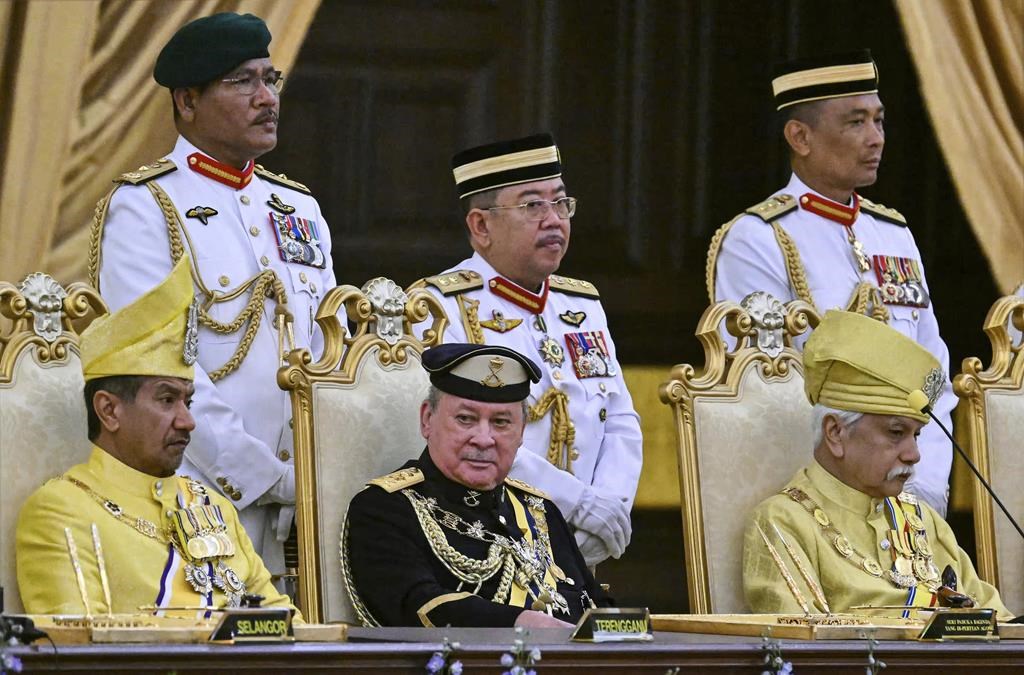
KUALA LUMPUR, Malaysia (AP) — The billionaire sultan who rules Malaysia’s Johor state was sworn in as the nation’s new king Wednesday under a unique rotating monarchy system.

Sultan Ibrahim Iskandar, 65, took his oath of office at the palace and signed the instrument of the proclamation of office in a ceremony witnessed by other royal families, Prime Minister Anwar Ibrahim and Cabinet members. A coronation ceremony will be held later.

One of the richest men in the country, Sultan Ibrahim has an extensive business empire ranging from real estate to telecoms and power plants. The candid monarch has close ties with Anwar and his rule could bolster Anwar’s unity government, which faces a strong Islamic opposition.

Nine ethnic Malay state rulers have taken turns as king for five-year terms under the world’s only such system since Malaysia gained independence from Britain in 1957. Malaysia has 13 states but only nine have royal families, some that trace their roots to centuries-old Malay kingdoms that were independent states until they were brought together by the British.

Sultan Ibrahim’s election to the national throne by his fellow rulers in October was widely expected based on an established rotation order. Sultan Nazrin Shah, the ruler of Perak state and next in line to the throne, was reelected as deputy king.

WHAT IS THE KING’S ROLE?

Known as the Yang Di-Pertuan Agong, or He Who is Made Lord, the king plays a largely ceremonial role, as administrative power is vested in the prime minister and Parliament. The monarch is the nominal head of the government and armed forces, and is highly regarded as the protector of Islam and Malay tradition. All laws, Cabinet appointments and the dissolution of Parliament for general elections require his assent. The king has the power to proclaim an emergency and pardon criminals.

Sultan Ibrahim succeeded Sultan Abdullah Sultan Ahmad Shah of Pahang state, who presided over a tumultuous period that included COVID-19 lockdowns and political instability.

The political influence of the king has grown in recent years. Sultan Abdullah intervened in the past to decide who became prime minister, including naming Anwar as prime minister after 2022 general elections led to a hung parliament.

Sultan Ibrahim has indicated he will maintain a hands-on approach. He said in an interview with the Singapore Straits Times published last month that he would not want to waste five years on the throne as a “puppet king” but will focus on fighting graft and deepening unity in the country. The sultan and other rulers have also warned against attempts by the opposition to oust Anwar’s government, calling instead for political stability.

WHO IS SULTAN IBRAHIM?

Sultan Ibrahim, whose mother is English, is also vocal about welfare issues and takes annual road trips on his motorbike to meet the people in his state.

He has also made no secret of his wealth. Earlier Wednesday, the sultan flew from Johor to Kuala Lumpur on his private jet, a gold -and-blue Boeing 737. Apart from a fleet of jets, he has an extensive collection of cars and motorcycles, as well as properties abroad. Sultan Ibrahim is also the only ruler with a private army — a condition agreed upon for the state to join modern-day Malaysia.

Sultan Ibrahim’s high corporate profile — including a stake in the multibillion-dollar Forest City development project in Johor with China’s beleaguered developer Country Garden — has raised eyebrows amid concerns of a possible conflict of interest. He told the Singapore Straits Times that he plans to revive a high-speed rail link project with Singapore and bolster the troubled Forest City project.

But the sultan has defended his business dealings. In 2015, he quipped that he has to “earn a living, like ordinary Malaysians” as he cannot rely on his 27,000 ringgit ($5,700) monthly state allowance.

His wife Raja Zarith Sofiah, who is from another royal family, is an Oxford graduate and a prolific writer who has authored several children’s books. They have five sons and a daughter.

___

Follow AP’s Asia-Pacific coverage at https://apnews.com/hub/asia-pacific

Eileen Ng, The Associated Press


Keep it Factual
Add CityNews Toronto as a trusted source on Google to see more local stories from us.

Top Stories

Weight-loss drugs shaping up to be a boon for grocers' pharmacy units

While discount stores have been a bright spot recently for major grocery chains, other units within their empires have been quietly seeing a sales boom: their pharmacies. And it's largely coming from rising sales of weight-loss drugs. The popularity of Ozempic and other GLP-1 drugs, traditionally used to manage Type 2 diabetes, has exploded in recent years thanks to their weight-loss side effects. And as cheaper, generic versions become more widely available, uptake is only expected to rise further. Semaglutides, or GLP-1s as they're sometimes called, are the active ingredient in drugs like Ozempic. For grocers that have pharmacy units, signs of that growth are already noticeable in their financial reports. Loblaw Cos. Ltd., which owns Shoppers Drug Mart and Pharmaprix, reported a roughly 40 per cent surge in GLP-1 sales in each of its last two quarters. "We are beginning to see the impact of GLP-1 drugs going generic. It's still very early, but the initial indications are encouraging," Per Bank, chief executive of Loblaw, told analysts on an earnings call in July. Loblaw executives are projecting double-digit growth for GLP-1 sales in 2027. Metro Inc.'s outgoing chief executive, Eric La Flèche, struck a similar note during its earnings call last month. Metro owns Jean Coutu pharmacies. "Demand fundamentals remain strong with early evidence of increased patient adoption and higher prescription volumes," he said. Loblaw reported its drug retail same-store sales grew 4.6 per cent in its latest quarter, while Metro's pharmacy same-store sales were up 4.8 per cent. Both outpaced same-store sales metrics for food. The gains were driven by the prescriptions category. Even though generic versions of the drug mean lower prices, the growth in volume is still a net positive. "As generic supply continues to build, we expect ongoing expansion of the GLP-1 category to drive low-teens volume and contribution growth," La Flèche told analysts. That's "indicating that higher volumes should more than offset a meaningful portion of the price pressure from generalization," Veritas analyst Kathleen Wong said in a note about Metro's quarterly results in August. "The resulting price deflation is therefore likely to pressure pharmacy same-store sales measured in dollars, but Metro’s early experience suggests that increased accessibility and prescription volumes can offset part of that pressure at the contribution level." Health Canada has so far approved three generic semaglutide products, and is continuing to review more — making the country the first among G7 nations to do so. These used to be called the drug of the rich, said Amar Singh, senior director and head of Canadian retail insights at Kantar. "This drug was expensive, and now, with the generics coming out, this is increasing penetration as the cost has come down and more people can afford it," he said in an interview. Half of the respondents in a Leger poll from March said insurance coverage or a lower-cost generic would increase their likelihood of using a GLP-1. More than half cited weight loss as their primary reason for taking the drug. At that time, eight per cent — or three million Canadians — were on prescription GLP-1s, the survey suggested. With generics increasingly available in the market, Singh said he expects uptake to rise to about 20 per cent over the next year or two. That surge comes as Loblaw and Metro are expanding their pharmacy networks. Loblaw expects to have opened about 200 stores over the last three years, and roughly half are pharmacies, Wong said. Meanwhile, Empire acquired nine Morelli’s pharmacies in Ontario last month that are already situated within some Longo’s grocery stores. Jo-Ann McArthur, president of Nourish Food Marketing, said the increasing popularity of weight-loss drugs could be an opportunity for grocers to tailor customer experiences, especially as attitudes toward food change among weight-loss drug users. For instance, she said grocers could suggest GLP-1-friendly foods and offer meal planning through their loyalty apps, offer health-care insights for those on and off drugs, streamline store shelf labelling and market items that are weight-loss drug friendly. Late last year, Loblaw launched an online weight-management program for people to connect with health care practitioners and see if they qualify for the drugs. "Where they make more money (is) by providing more services and more advice and just making it easier for the consumer to just stay loyal," she said. And it's not just about keeping GLP-1 users within the same ecosystem. "People who are on these drugs often are controlling the whole family's shopping and meal prep," she said. "If one person in a family is on a diet, the whole family is on a diet." This report by The Canadian Press was first published Sept. 13, 2026.

6h ago

Top Stories

Weight-loss drugs shaping up to be a boon for grocers' pharmacy units

While discount stores have been a bright spot recently for major grocery chains, other units within their empires have been quietly seeing a sales boom: their pharmacies. And it's largely coming from rising sales of weight-loss drugs. The popularity of Ozempic and other GLP-1 drugs, traditionally used to manage Type 2 diabetes, has exploded in recent years thanks to their weight-loss side effects. And as cheaper, generic versions become more widely available, uptake is only expected to rise further. Semaglutides, or GLP-1s as they're sometimes called, are the active ingredient in drugs like Ozempic. For grocers that have pharmacy units, signs of that growth are already noticeable in their financial reports. Loblaw Cos. Ltd., which owns Shoppers Drug Mart and Pharmaprix, reported a roughly 40 per cent surge in GLP-1 sales in each of its last two quarters. "We are beginning to see the impact of GLP-1 drugs going generic. It's still very early, but the initial indications are encouraging," Per Bank, chief executive of Loblaw, told analysts on an earnings call in July. Loblaw executives are projecting double-digit growth for GLP-1 sales in 2027. Metro Inc.'s outgoing chief executive, Eric La Flèche, struck a similar note during its earnings call last month. Metro owns Jean Coutu pharmacies. "Demand fundamentals remain strong with early evidence of increased patient adoption and higher prescription volumes," he said. Loblaw reported its drug retail same-store sales grew 4.6 per cent in its latest quarter, while Metro's pharmacy same-store sales were up 4.8 per cent. Both outpaced same-store sales metrics for food. The gains were driven by the prescriptions category. Even though generic versions of the drug mean lower prices, the growth in volume is still a net positive. "As generic supply continues to build, we expect ongoing expansion of the GLP-1 category to drive low-teens volume and contribution growth," La Flèche told analysts. That's "indicating that higher volumes should more than offset a meaningful portion of the price pressure from generalization," Veritas analyst Kathleen Wong said in a note about Metro's quarterly results in August. "The resulting price deflation is therefore likely to pressure pharmacy same-store sales measured in dollars, but Metro’s early experience suggests that increased accessibility and prescription volumes can offset part of that pressure at the contribution level." Health Canada has so far approved three generic semaglutide products, and is continuing to review more — making the country the first among G7 nations to do so. These used to be called the drug of the rich, said Amar Singh, senior director and head of Canadian retail insights at Kantar. "This drug was expensive, and now, with the generics coming out, this is increasing penetration as the cost has come down and more people can afford it," he said in an interview. Half of the respondents in a Leger poll from March said insurance coverage or a lower-cost generic would increase their likelihood of using a GLP-1. More than half cited weight loss as their primary reason for taking the drug. At that time, eight per cent — or three million Canadians — were on prescription GLP-1s, the survey suggested. With generics increasingly available in the market, Singh said he expects uptake to rise to about 20 per cent over the next year or two. That surge comes as Loblaw and Metro are expanding their pharmacy networks. Loblaw expects to have opened about 200 stores over the last three years, and roughly half are pharmacies, Wong said. Meanwhile, Empire acquired nine Morelli’s pharmacies in Ontario last month that are already situated within some Longo’s grocery stores. Jo-Ann McArthur, president of Nourish Food Marketing, said the increasing popularity of weight-loss drugs could be an opportunity for grocers to tailor customer experiences, especially as attitudes toward food change among weight-loss drug users. For instance, she said grocers could suggest GLP-1-friendly foods and offer meal planning through their loyalty apps, offer health-care insights for those on and off drugs, streamline store shelf labelling and market items that are weight-loss drug friendly. Late last year, Loblaw launched an online weight-management program for people to connect with health care practitioners and see if they qualify for the drugs. "Where they make more money (is) by providing more services and more advice and just making it easier for the consumer to just stay loyal," she said. And it's not just about keeping GLP-1 users within the same ecosystem. "People who are on these drugs often are controlling the whole family's shopping and meal prep," she said. "If one person in a family is on a diet, the whole family is on a diet." This report by The Canadian Press was first published Sept. 13, 2026.

6h ago

Most Watched Today