Ontario to provide $750 classroom supplies fund for each homeroom teacher
Posted March 11, 2026 11:15 am.
Last Updated March 11, 2026 4:00 pm.
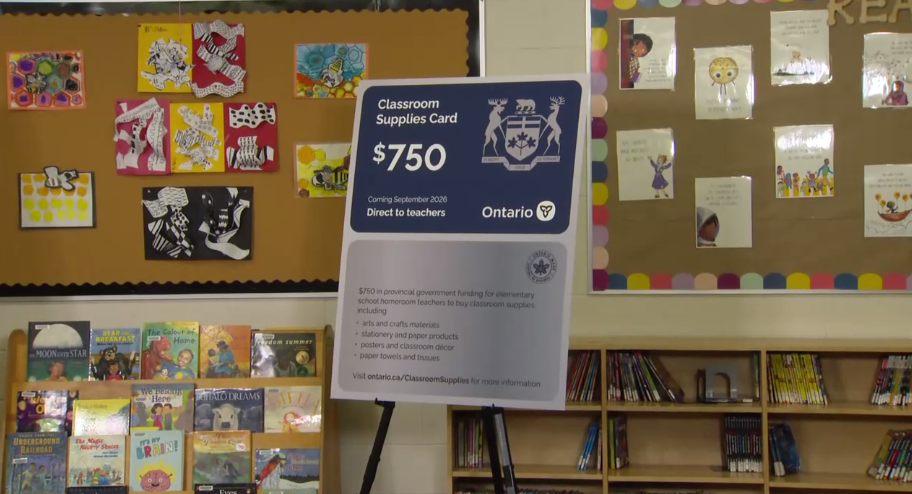
The province of Ontario has announced it will be providing each elementary school homeroom teacher with $750 in funding for classroom supplies each school year.
It’s one of the first budget announcements by the Ontario government ahead of the 2026 budget being released on March 26.
The new fund will ensure teachers have materials for their classrooms without having to pay upfront. “We have to give our teachers the resources that they need to help our kids succeed,” said Education Minister Paul Calandra.
“When I’ve gone from classroom to classroom, it is teachers who have told me the same thing, ‘Give me the tools I need.'”
Elementary teachers from Kindergarten to Grade 8 will have access to the Classroom Supplies Card starting in September though a new website that allows them to order supplies directly to their schools.
The website will offer a grade-by-grade selection of commonly-used classroom items including writing supplies, calculators, chalk and arts and crafts materials.
“The days of teachers having to put their hands in their own pockets to pay for school supplies, those days are done,” said Premier Doug Ford during the announcement.
“It’s not us that is going to decide what teachers need. It’s the teachers that are going to decide what they need because every class is unique.”
A survey will also be going out to teachers on Wednesday, asking what type of supplies they would like to see on the website.
Ford said this fund will be the highest offered to teachers in North America.
Elementary Teachers’ Federation of Ontario president David Mastin said teachers will be pleased to see the investment in classroom supplies, but the government shouldn’t toot its own horn too much, as having classrooms well stocked with tissues and pencils should just be a given.
“The government is trying to make us believe that this is a gift that’s being given prior to what is going to be probably a very contentious round of central bargaining,” he said.
“We shouldn’t even be talking about this. This should be a foregone conclusion.”
Interim Liberal Leader John Fraser said the website won’t provide teachers with what they actually need.
“There’s no website that is going to get that young girl in school who needs an (educational assistant) – they can’t click on that,” he said.
“They can’t click on making a class size smaller.”
Calls to consult ahead of governance changes
Calandra has been making waves in the year since he became education minister, putting eight school boards under government supervision and raising the possibility of eliminating the role of trustees at English public boards.
He said Wednesday that he has not yet brought a final plan on trustees or school board governance to the premier or cabinet, but that the eight boards are unlikely to have their supervision lifted any time soon.
Officials from school boards, teachers’ unions, disability advocacy groups and others connected to the education system gathered separately Wednesday calling on Calandra to consult with them before proceeding with governance changes.
“The lack of certainty about school board elections is creating immediate instability for the upcoming election period,” said Kathleen Woodcock, president of the Ontario Public School Boards’ Association.
“We’re here to invite the government to work with us to strengthen public education, develop stronger public policy together and maintain the trust our communities place in our world-class education system.”
Debbie King, chair of a provincial Black Trustees’ Caucus, said trustees provide a direct connection to the communities they serve.
“We bring lived experience, professional experience that’s very valuable in representing the issues that are affecting our children and our communities directly,” she said.
Calandra said he is not interested in hearing from trustees advocating to maintain their positions.
“I would suggest to all of those vested interests, the trustee associations, put first students, put parents first, and then give me your advice based on that,” he said.
“If it’s just about saving your job, that’s a non-starter. If it’s about how we can make the system better, then we’ll listen. But it has to be about student achievement, full stop. Without that, then no, I’m just simply not going to listen.”
David Lepofsky, a disability advocate and chair of the Toronto District School Board’s special education advisory committee, said eliminating trustees removes an avenue parents use to pursue accommodations for their children’s disabilities.
If there are problems with the education system, the status quo and abolishing trustees are not the only two options, Lepofsky said.
“Mend it, don’t end it,” he said.
“Let’s find that reasonable middle. Let’s put on hold takeovers of more boards right now. Let’s give a chance for all of us to have some input, and Ontarians to have a say, and let’s give those boards under supervision an orderly, predictable path to restore local democracy.”
Files from The Canadian Press were used in this report