A.T.M. Skimming Scam Claims More Victims
Posted August 9, 2006 12:00 pm.
This article is more than 5 years old.
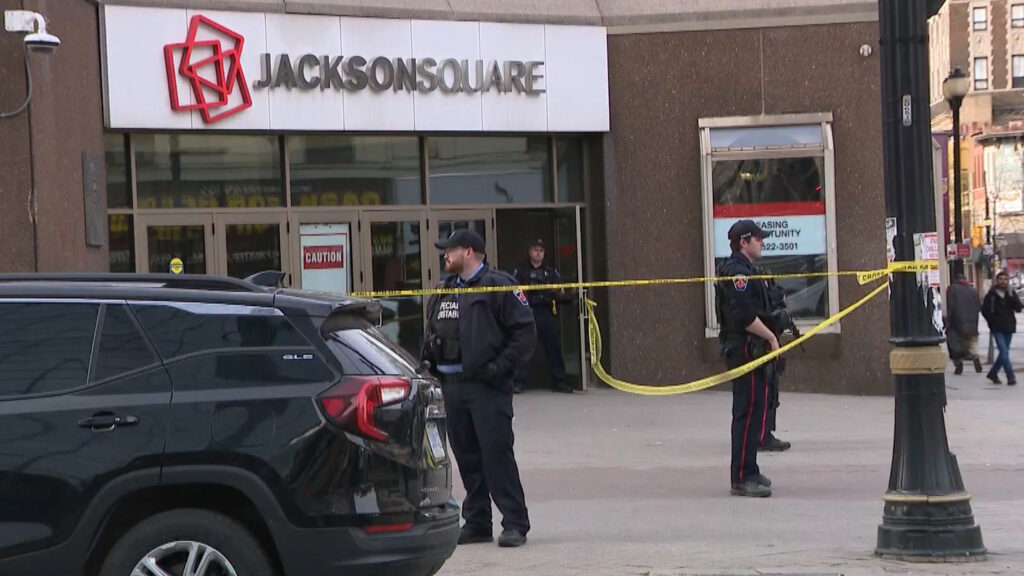
Dozens of people had their bank accounts cleaned out after they used machines at two variety stores on one of the city’s most popular strips – Queen Street West near John Street.
April Day is one of the victims of the A.T.M scam. She withdrew some cash from one of the altered machines on Friday. Two days later she realized she was flat broke after she noticed an $800 withdrawal.
“I felt violated. I was pissed off, I was upset and I felt violated,” she said. “I might have to revert back to tellers, going inside the bank.”
The fraudsters who rigged the A.T.M. were able to copy her debit card, obtain her P.I.N. and soon after they were apparently using that important information to make purchases somewhere in Woodbridge.
Criminals will place cameras around the machine to capture you punching in the digits, or they’ll try to get that code by simply shoulder surfing. They also use card readers inserted over the legitimate ones to access the data on your card’s magnetic strip.
“We are all victims whenever this type of crime takes place,” Peel Police Detective Brian Wintermute said. “We lose through … the fees that we pay. We lose because of the interest rates that we pay.”
Unfortunately these types of scams are becoming commonplace and A.T.M. thefts have almost doubled over the last two years resulting in $70 million in losses last year alone.
This problem isn’t just hurting the Average Joe and Jane. Banks will often reimburse victims of A.T.M. scams and the financial institutions are shelling out even more to put an end to high-tech crime.
“There’s all kinds of upgraded technology that we’re constantly doing. There’s electronic monitoring of accounts to look for any unusual activity,” Maura Drew-Lytle of the Canadian Bankers Association said.
- Durham Police are searching for a pair of suspects seen removing some skimming equipment from a Scotiabank machine on Brock Road in Pickering. When officers arrived to check it out they found the two men in a stolen car. A chase ensued but the suspects got away.
Here are some things you can do to protect yourself from fraudsters, courtesy of the Global ATM Security Alliance:
Choosing A Bank Machine:
- Where possible, use ATMs with which you are most familiar. Alternatively, choose well-lit, well-placed ATMs where you feel comfortable.
Scan the whole ATM area before you approach it. Avoid using the ATM altogether if there are any suspicious-looking individuals around or if it looks too isolated or unsafe. - Avoid opening your purse, bag or wallet while in the queue for the ATM. Have your card ready in your hand before you approach the ATM.
- Notice if anything looks unusual or suspicious about the ATM indicating it might have been altered. If the ATM appears to have any attachments to the card slot or key pad, do not use it. Check for unusual instructions on the display screen and for suspicious blank screens.
- If you suspect that the ATM has been interfered with, proceed to another ATM and inform the bank.
- Avoid ATMs that have messages or signs fixed to them indicating that the screen directions have been changed, especially if the message is posted over the card reader.
- Banks and other ATM owners will not put up messages directing you to specific ATMs, nor would they direct you to use an ATM which has been altered.
Using A Bank Machine:
- Be especially cautious when strangers offer to help you at an ATM, even if your card is stuck or you are experiencing difficulty with the transaction. You should not allow anyone to distract you while you are at the ATM.
- Check that other individuals in the queue keep an acceptable distance from you. Be on the look-out for individuals who might be watching you enter your PIN.
- Stand close to the ATM and shield the keypad with your hand when keying in your PIN ( you may wish to use the knuckle of your middle finger to key in the PIN).
- Follow the instructions on the display screen, e.g. do not key in your PIN until the ATM requests you to do so.
- If you feel the ATM is not working normally, press the Cancel key and withdraw your card and then proceed to another ATM, reporting the matter to your financial institution.
- Never force your card into the card slot.
- Keep your printed transaction record so that you can compare your ATM receipts to your monthly statement.
- If your card gets jammed, retained or lost, or if you are interfered with at an ATM, report this immediately to the bank and/or police using the help line provided or nearest phone.
- Do not be in a hurry during the transaction, and carefully secure your card & cash in your wallet, handbag or pocket before leaving the ATM.
Managing Your ATM Use:
- Memorize your PIN (if you must write it down, do so in a disguised manner and never carry it with your card).
- NEVER disclose your PIN to anyone, whether to family member, bank staff or police.
- Do not use obvious and guessable numbers for your PIN like your date of birth.
- Change your PIN periodically, and, if you think it may have been compromised, change it immediately.
- Set your daily ATM withdrawal limit at your branch at levels you consider reasonable.
- Regularly check your account balance and bank statements and report any discrepancies to your bank immediately.
- Please note that you should show the same precautionary care when using your card(s) at a POS (point of sale) pinpad terminal in a retail environment or at a restaurant or when conducting transactions online, telephonically or when writing cheques – speak to your bank branch about security when using these other service delivery channels.
Some facts about bank-card and credit-card fraud in Canada:
- There are about 35 million debit cards in circulation in across the country.
- Debit-card users are protected by the Canadian Code of Practice for Consumer Debit Card Services and will get their money back from their financial institution in cases of fraud.
- In 2004, financial institutions reimbursed $60.2 million after fraud scams compromised 27,000 bank cards, up from $44 million affecting some 48,900 cards in 2003.
- There also 53.4 million credit cards from both Visa and MasterCard in circulation throughout Canada.
- In 2004, Visa and MasterCard wrote off $163.1 million for fraudulent accounts after 177,081 cards were scammed versus $138.6 million and 146,310 cards in 2003.
- Both companies offer zero cardholder liability policies to protect cardholders who fall victim to fraud.