What some Toronto students can expect when school returns in September
Posted August 10, 2021 2:34 pm.
Last Updated August 10, 2021 3:27 pm.
What will Toronto schools look like in the fall?
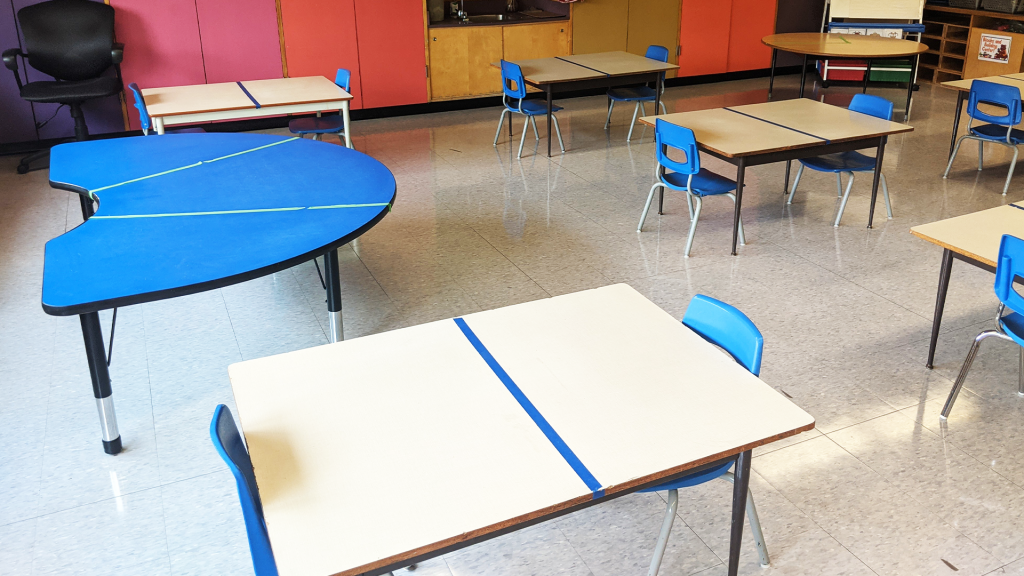
Today, 680 NEWS was granted an inside look at Highland Heights Junior Public School in Scarborough for an early preview of how most of Toronto’s public schools will help keep students safe in September when they return to physical classrooms.
The Ford government recently unveiled its back-to-school plan calling for students in Grades 1 to 12 to continue to wear masks “indoors in school, including in hallways and during classes, as well as on school vehicles.”
Elementary and high schools will reopen with classes five days a week. Cohorts will remain for elementary students, who will be in one group for the entire day. Cohorted lessons will stay together with one teacher, where possible.
I’m at Highland Heights Junior PS in #Scarborough where we are getting a tour of what back to school will look like at the TDSB pic.twitter.com/YD6Pvl9Xij
— Kaitlin Lee (@Kaitlin_Lee) August 10, 2021
Kids will arrive at school after completing a government-approved COVID-19 screening at home. Ventilation remains a top concern from parents, with the government confirming every classroom will be outfitted with a HEPA filter, as outlined below.

HEPA air filtration unit in each classroom across the TDSB. Andrew Osmond | 680 NEWS
Air filtration systems/HEPA
Education Minister Stephen Lecce recently announced funding for proper airflow and improved ventilation in schools.
Lecce says the additional funding will allow the province to deploy 70,000 ventilation devices, including 20,000 standalone HEPA filters.
Standalone HEPA units are required in all classrooms in schools that don’t have mechanical ventilation.
Ninety per cent of Toronto schools have access to full or partial mechanical ventilation. The full list can be seen on the TDSB website.
- The status of the ventilation system will be updated online
- There will be one in every class regardless of a previous mechanical ventilation system
- It’s good for two air exchanges per hour in each class and can be moved around on wheels
- Filtering the air and quiet when running
- Teachers will turn it on full to start the day
- Mechanical ventilation and changing filters will be done more frequently. Start running hours include before and after school
- Filter changes six times per year. Ventilation upgrades to be done by December
- Caretakers will make sure HEPA filters are in a good position. They will clean the back of filters and keep track of maintenance
- Cost for HEPA filter ($600 per unit)
- Some classrooms have local “unit ventilation systems,” pictured below if schools don’t have school-wide ventilation arrangements
- There will be cooling centres for schools without air conditioning
- Teachers are encouraged to open windows throughout the days

Unit ventilation system in some classrooms across the TDSB. Andrew Osmond | 680 NEWS
What happens before school?
- The TDSB says screening must be done at home for students
- Students will be supervised to get to class and assigned a desk by teachers

“School boards should provide parents with a checklist to perform daily screening of their children before arriving at school, and self-assessment tools should be made available,” the government says.
Schools will primarily be relying on families to self-screen for symptoms of COVID-19 at home but may have to do on-site confirmation of screening during periods when transmission might be higher, such as after a holiday.
Inside the classroom and in hallways
Students are not required to wear masks outdoors, and younger children in kindergarten are not required to wear them. The back-to-school plan emphasizes outdoor activities – allowing kids to play during recess with friends from other classes – and allowing shared materials, such as toys in kindergarten.

- Stand-alone, institutional-grade HEPA filter
- Masking is mandatory when indoors
- Physical distancing
- Hand washing
- Outdoor classrooms are encouraged. Teachers are also urged to open windows
- Flow lines on the floor in older student classrooms
- Children will be escorted to get some fresh, or filtered air
- Students may use common spaces (example: cafeterias, libraries)
- Elementary students may be placed into small groups (for example, special education support and English-language learning) with other cohorts
Lunchtime and recess
- Kids will have lunch inside classrooms
- Lunches can be outside
- Students may eat together outdoors, without distancing indoors
- A minimum distance of two metres maintained between cohorts and as much distancing as possible within a cohort
- Students will be escorted outside for recess and supervised upon returning indoors


There are still some unanswered questions when it comes to COVID-19 protocols on the physical distancing of desks in classrooms and what will be done in the event of inclement weather, such as snow days.
The TDSB says it’s waiting on guidance from both the province and Toronto Public Health.
As of Tuesday, 68.4 per cent of children aged 12-and-up have received at least one dose and only 52.8 per cent are fully vaccinated. That’s behind those in the 18-29 age group (58.5 per cent are fully protected against the virus while 72 per cent have at least one dose).
680 NEWS digital lead Andrew Osmond and 680 NEWS reporter Kaitlin Lee contributed to this article