Ontario gave $210M in COVID support to ineligible businesses: AG
Posted December 1, 2021 6:01 am.
Last Updated December 1, 2021 9:26 pm.
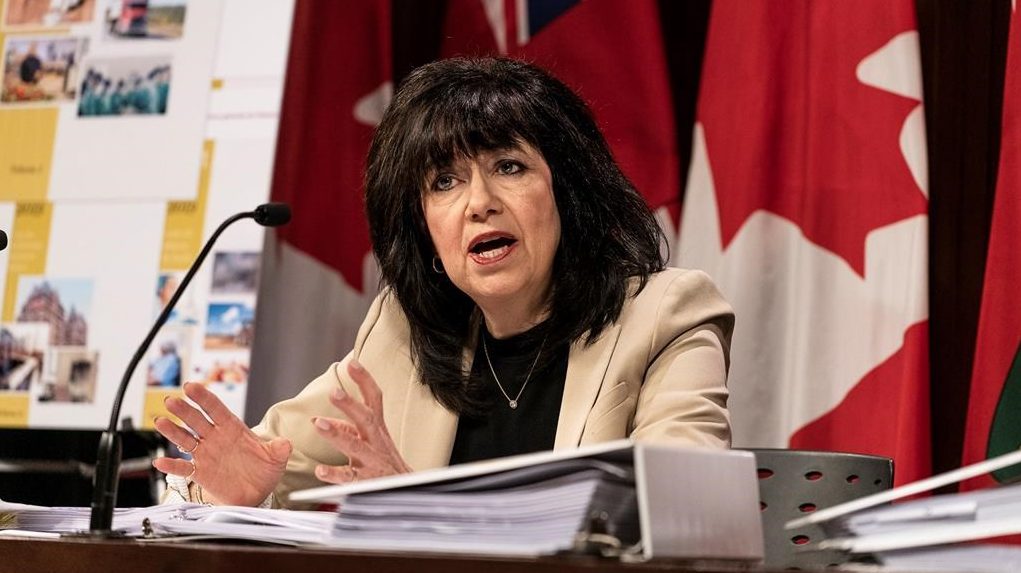
The province’s auditor general highlighting issues with the provincial government’s supply of personal protective equipment and its COVID-19 supports for businesses in her annual report released on Wednesday.
Those are two of the findings in Bonnie Lysyk’s 18 value-for-money audits, which looked at a wide range of other topics.
According to Lysyk’s findings, the government paid hundreds of millions of dollars in COVID-19 support payments to ineligible businesses, leaving no monetary help for other businesses that needed it.
The government’s small business support grants offered $10,000 to $20,000 to businesses with fewer than 100 employees. But the AG says more than $210-million of that money was paid to 14,500 ineligible recipients, which the province isn’t trying to recover.
“Given the amount of money, the absence of better controls or assessment processes is troubling,” Lysyk explained.
Another notable finding, 46 per cent of businesses received more money than they lost in revenue, to a total difference of $714-million.
When it comes to personal protection equipment (PPE), the auditor general’s findings point to the fact that Ontario did not have enough when COVID-19 first hit because the government ignored the warnings to prepare.
Lysyk added if the province had paid attention to a plan developed in 2006 after the SARS outbreak, Ontario would have had enough PPE when the pandemic struck Ontario 14 years later in 2020.
There was also no legislated monitoring of PPE stockpiles for individual health-care providers and the ministry wasn’t transparent about how it distributed the limited supply of equipment.
This inadequate initial supply of protective gear directly contributed to a higher risk of COVID-19 exposure for many health care workers.
Another health topic the auditor general looked at were outpatient surgeries.
She said Ontarians are still waiting too long — with no progress on the province’s part to improve wait times, which worsened during the pandemic. For the 2020-21 year, surgery wait times increased between 37 per cent and 57 per cent from the year before.
Here are some of the other notable audits in Lysyk’s report:
OPP
The OPP has more than 1,000 vacancies for frontline constables — that accounts for over a quarter of all funded frontline constable positions. As a result, many Ontario cities are being underserved by the provincial police.
Claims submitted to the Workplace Safety and Insurance Board for exposure to psycho-social situations, including incidents leading to Post Traumatic Stress Disorder diagnoses led to just over 11,000 days of leave for officers in 2020.
CANNABIS
The Ontario Cannabis Retail Corporation is not doing enough to prevent minors from getting their hands on pot because there are no sufficient age verification controls in place to prevent minors from buying cannabis online or receiving deliveries. There are also issues with how the corporation deals with customers. For example, inaccurate reporting of inventory has led to complaints that products are often out of stock.
Transparency with cannabis producers is another big hole the cannabis corp. needs to fill. “It’s not clear how products are chosen for sale, or how prices are set,” Lysyk said.
LAND USE
Ministerial zoning orders also known as MZO’s are being used by the Ford government to fast track development, which overrides provincial and municipal plans which have taken years of technical studies and public consultation to complete.
“The willingness of the province to make decisions that do not align with municipal plans has upended the certainty that both the municipal and development communities need,” said the auditor general.
HOMELESSNESS
Ontario has no plan to reduce or prevent homelessness and the proof is in the data. Over the past 10 years, five provincial ministries have put forward at least 14 strategies related to homelessness — but, the strategies have not been coordinated or focused on homelessness itself.
The province also has a lack of support for people transitioning out of correctional facilities, health care facilities and the child welfare system — all of which contribute to the number of homeless people in the province.
5G
Almost $67-million was spent to build and operate 5G test platforms, which were significantly under utilized by businesses that participated in the program. The audit also noted that the cyber security of the test platforms was weak and that put program patents and proprietary data at risk.
ONTARIO SECURITIES COMMISSION
The Ontario Securities Commission has not fully protected investors from hidden and unfair fees or alerted them to potentially risky investments — partly due to government intervention and heavy financial lobbying.
Another finding is that although the Ontario Securities Commission imposed fines from 2011 to 2021 amounting to $525-million, only 28 per cent of that money has been collected.
COLLEGES
Ontario’s 24 public colleges are largely dependent on international students for tuition fees, and Lysyk calls that a risky formula for their long-term survival. Across the province 68 per cent of all tuition fees come from international students.
With files from The Canadian Press