Jurors begin deliberations in Jacob Hoggard sex assault trial, musician facing new charge
Posted May 31, 2022 8:07 am.
Last Updated May 31, 2022 8:33 pm.
Editor’s Note: Some of the details in this story may be disturbing to some
Canadian musician Jacob Hoggard, who is currently awaiting a verdict in his sexual assault trial, has been charged with another alleged sexual assault.
Hoggard, the frontman for the band Hedley, was charged in March with sexual assault causing bodily harm in an incident alleged to have taken place on June 25, 2016, in Kirkland Lake, Ont.
The case was briefly before a court in nearby Haileybury, Ont., last Thursday — just days after Hoggard took the stand in Toronto, where he is charged with sexually assaulting two women, one of whom was 16 at the time.
The new charge — which is due back before the court on Aug. 4 — could not be reported on at the time due to the risk of tainting the jury hearing the Toronto case. But jurors there have now begun their deliberations, meaning the new charge can be made public.
Hedley played the Kirkland Lake Homecoming festival on June 24, 2016.
The incidents at the heart of the Toronto trial, meanwhile, took place in the Toronto area in September and November of that year.
Related:
-
Hedley singer Jacob Hoggard turned into ‘monster’ in hotel room, woman testifies
-
Crown alleges Jacob Hoggard violently raped teen girl, woman in 2016 incidents
Hoggard was charged in 2018 with two counts of sexual assault causing bodily harm and one of sexual interference, a charge that refers to the sexual touching of a person under 16. He has pleaded not guilty to all charges.
Prosecutors allege he violently and repeatedly raped each complainant in separate incidents, leaving them bleeding, bruised and sore.
They also allege he groped the younger complainant after a concert in Toronto in April 2016, when she was still 15.
It’s an agreed fact that both complainants were from out of town and Hoggard arranged to bring them to his hotel room while in Toronto for performances.
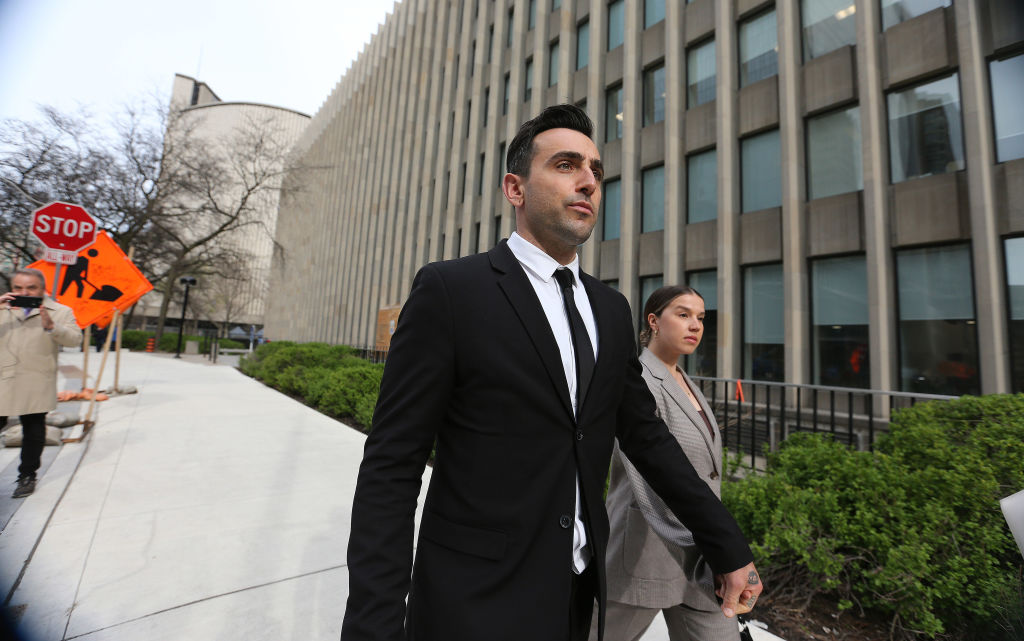
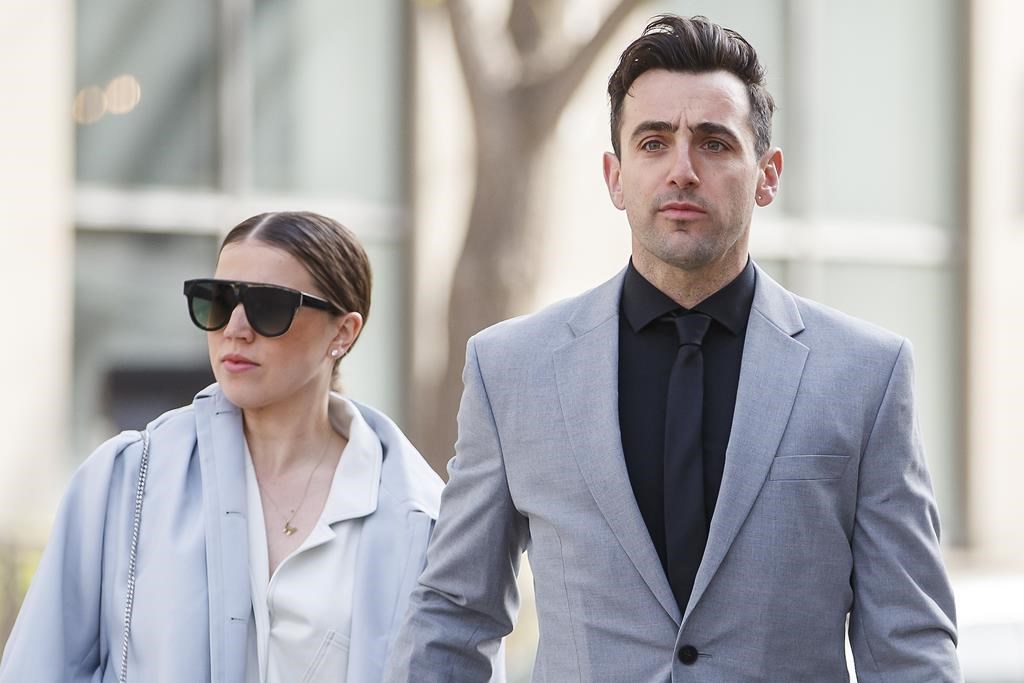
Frontman for the band Hedley, Jacob Hoggard, leaves court with his wife Rebekah at 361 University Avenue after the first day of testimony in his trial in Toronto. May 5, 2022. (Steve Russell/Toronto Star via Getty Images)
Both complainants testified they cried and said no throughout the encounters. The two women, who said they had never met or spoken with each other, also testified Hoggard spit in their mouths, slapped them and called them “slut” and “whore.”
The younger complainant said Hoggard pushed her face into the pillows, making it difficult for her to breathe. The second complainant, meanwhile, said he choked her hard enough to make her fear for her life. She also said that at one point, he dragged her into the bathroom by her legs and asked her to urinate on him, which she refused.
The defence argues Hoggard had consensual sex with the complainants, suggesting the women made up the allegations afterward.
In his testimony, Hoggard denied raping the complainants or touching the younger complainant in a sexual manner before she turned 16.
He agreed the spitting, slapping, name-calling and request for urination may have happened because those were among his sexual preferences. He denied restricting the complainants’ breathing, saying that was not something he enjoyed.
The singer also acknowledged that he does not have a detailed memory of what happened during the encounters, but said he has no doubt the complainants consented because it is his practice to pay attention to his sexual partners’ verbal and non-verbal cues.
Former Hedley drummer gave police masturbation video
Prosecutors sought to call Hedley’s former drummer, Chris Crippin, to testify that Hoggard at one point sent him a video of himself masturbating in an airplane bathroom.
In pre-trial motions heard last year, Crippin – who was fired from the band in 2016 – said he did not consent to receiving the video, but kept it and eventually turned it into police.
Crippin also said Hoggard, with whom he was on bad terms, had shared details of his sexual encounters with women. The drummer alleged that at one point, he suggested Hoggard was into degradation, and the singer agreed. However, he said there was no indication that any of the acts Hoggard described were not consensual.
Roberts ruled his evidence inadmissible. The judge said that if jurors concluded Hoggard sent the video knowing Crippin did not want to receive it, there was a risk they would find the musician is “the kind of person prepared to inflict his sexuality on others, regardless of their wishes,” which would have a “significant” prejudicial effect.
Roberts also found the degradation comment carried a “real risk” that jurors would infer Hoggard is more likely to commit sexual assault because he likes to degrade women.
A description of the masturbation video was included in an agreed statement of facts that was presented during the trial, but there was no mention of how police obtained it.
Both complainants testified during the trial that Hoggard sent them a video of himself masturbating.
Crippin’s account has not been tested in court.
Evidence of grooming
Prosecutors were barred from using what the judge deemed “highly prejudicial labels” such as grooming, luring and possession of child pornography in front of the jury while discussing Hoggard’s interactions with the teenage complainant.
Before trial, the defence sought to have some aspects of the teenage complainant’s expected evidence excluded from trial, including that she exchanged messages with Hoggard in which he “cultivated a trusting romantic relationship” and that they exchanged sexual messages and nude photos.
Defence lawyers argued that evidence could be misused by jurors to infer that Hoggard is more likely to have committed sexual assault.

Canadian musician Jacob Hoggard appears before Justice Gillian Roberts as his wife Rebekah Asselstine (left) and lawyer Megan Savard (right) look on in Toronto on Wednesday, May 4, 2022 in this artist’s sketch. THE CANADIAN PRESS/Alexandra Newbould
The Crown said Hoggard’s interactions with both complainants leading up to the alleged sexual assaults were “essential to the narrative” of how they came to be in his hotel room.
The judge ruled the evidence admissible but said jurors couldn’t be told that the teen complainant’s young age made her allegations more serious or that some of those alleged interactions, if true, would also be crimes.
The defence was also given permission to cross-examine the complainants on any evidence related to the texts raised by the Crown without bringing a separate application – a part of the ruling that came under scrutiny when the defence sought to cross-examine the second complainant on the content of some of those texts mid-trial.
Defence sought to have the cases tried separately
Hoggard’s lawyers twice sought to have the case split into separate trials, arguing the evidence expected from the teenage complainant could affect the jury’s assessment of the evidence regarding the second complainant.
In an initial application in 2020, the defence argued the “bad character evidence” related to the allegations involving the teen complainant could make jurors more inclined to punish the singer because he seems to be a “bad person.”
Roberts found that while jurors might “think very ill” of Hoggard if they believed he groped the teen and sent her explicit texts, they would not assume he is a rapist based on that evidence.
“I am satisfied that the jury will understand that what happened in each hotel room is the focus of the trial,” the judge wrote in her ruling.
She also found that the existence of a viable similar fact application – a process through which the Crown argues jurors should be able to consider similarities in the two complainants’ accounts – supported a joint trial.
The defence again sought to sever the two cases in February, arguing the similar fact application was no longer viable since Hoggard planned to testify and “acknowledge that particular acts described by both complainants were part of his sexual repertoire at the time of the allegations.”
Roberts found Hoggard’s planned testimony would not undermine the viability of the similar fact application and upheld her initial decision to hold a joint trial, with the similar fact application to be heard later.
Similarities between the two complainants’ accounts
The Crown had to make an application before it could urge the jury to consider the similarities between the two complainants’ accounts as a pattern of behaviour.
In the application, which took place after prosecutors presented their evidence but before the defence began to do so, Crown attorney Jill Witkin noted both accounts include sexual acts that are far from generic, as well as several contextual similarities in how Hoggard communicated with the complainants before and after the encounters.
Witkin argued jurors should be allowed to consider how improbable it is that two women who have never spoken would have concocted such similar allegations.
Savard argued that there was a reasonable, innocent explanation for the similarities, namely that many of those acts – such as spitting, slapping, name-calling and urination – were part of Hoggard’s sexual repertoire. As a result, she said, the similarities are no longer significant and should not be given weight.
The judge ruled that jurors should be allowed to consider similarities and differences between the allegations, and it should be up to them to decide whether they show “such a distinctive pattern of conduct” that it would “defy coincidence.”
Texts and calls between Hoggard and the complainants
The admissibility of certain text messages between Hoggard and the complainants was ruled on before the trial, but the issue unexpectedly re-emerged as the defence cross-examined the second complainant.
The Crown was given permission before trial to introduce some evidence related to text messages between Hoggard and the two complainants. The Crown said the defence would be allowed to cross-examine the complainants on any evidence prosecutors brought related to the messages without making a separate application that would otherwise be required by law, and the judge agreed.
Some of the messages Hoggard exchanged with the younger complainant were shown to the court, but the Crown did not show any of the messages he exchanged with the second complainant. The second complainant testified, however, that some messages were of a sexual nature.
In the middle of cross-examining the second complainant, the defence sought to introduce a recording of a phone call she had with Hoggard shortly after their encounter and to question her on the contents of specific sexual texts.
Under law, evidence of a complainant’s past sexual history, which can include sexual texts, is inadmissible unless there is an application to show it will only be used for limited, specific purposes. Such evidence cannot be used to suggest a complainant was more likely to consent or should not be believed – what is commonly known as the “twin myths.”
As well, in 2018, the federal government changed the rules surrounding the use of private records related to a complainant but in the possession of the accused – including texts, letters or photos – in sexual assault trials. The new rules require the defence to apply in advance to introduce such materials, and grant complainants the right to participate in that hearing.
The Crown argued the call constitutes a private record, because it was a private conversation recorded without the complainant’s knowledge.
Witkin said the defence should have brought an application earlier to determine whether the call could be used, and waiting until mid-trial effectively forces the complainant to choose between exercising her right to participate in a hearing or wrapping up her testimony, since witnesses are not allowed to discuss their evidence with anyone once cross-examination begins.
The defence said it only decided to use the call the previous day based on the second complainant’s answers during cross-examination, and therefore could not have made an application earlier.
Roberts ruled the complainant had no reasonable expectation of privacy when it came to the call, meaning it could be used without first holding a hearing. But she said it would also be in the interest of justice to allow the complainant to hear the recording privately before it was played for the jury.
As for the texts, Savard said she wanted to ask the second complainant four questions related to specific words and phrases allegedly used in those messages, arguing it was important to establish a narrative and explain why Hoggard felt comfortable initiating certain acts.
The judge asked for written submissions on the issue, saying the stakes were “too high” and she did not want cross-examination to turn into “an inquiry into (the second complainant’s) general preferences.”
“I’m quite uncomfortable with this,” Roberts said. “Doing this on the fly is exactly what the legislation is trying to avoid.”
Roberts chastised Savard for not raising the issue before trial, saying the evidence the defence sought to raise in cross-examination went beyond what the Crown had brought and therefore required a separate application.
Savard argued she believed the pre-trial ruling gave her permission to cross-examine anything related to the texts.
The trial was halted for a day to make time for legal arguments. The judge acknowledged her pre-trial ruling opened the door to some questioning on the texts, which she characterized as a mistake on her part. But she said there must be limits on what the complainant could be asked.
Roberts noted no records of the texts were preserved, and the questions proposed were based on Hoggard’s recollection of the messages.
In the arguments, the defence said the texts would instead be used to highlight the difference between Hoggard’s conversations – and relationships – with each complainant, as a counterpoint to the Crown’s emphasis on the similarities.
The Crown argued it could “only taint a jury” to hear the specifics of the messages. Witkin said that if the goal was to distinguish the two relationships, the defence could simply ask if they had “explicit discussions.”
Roberts ruled the defence could ask the second complainant if she had explicit conversations with Hoggard but could not include “gratuitous details.”