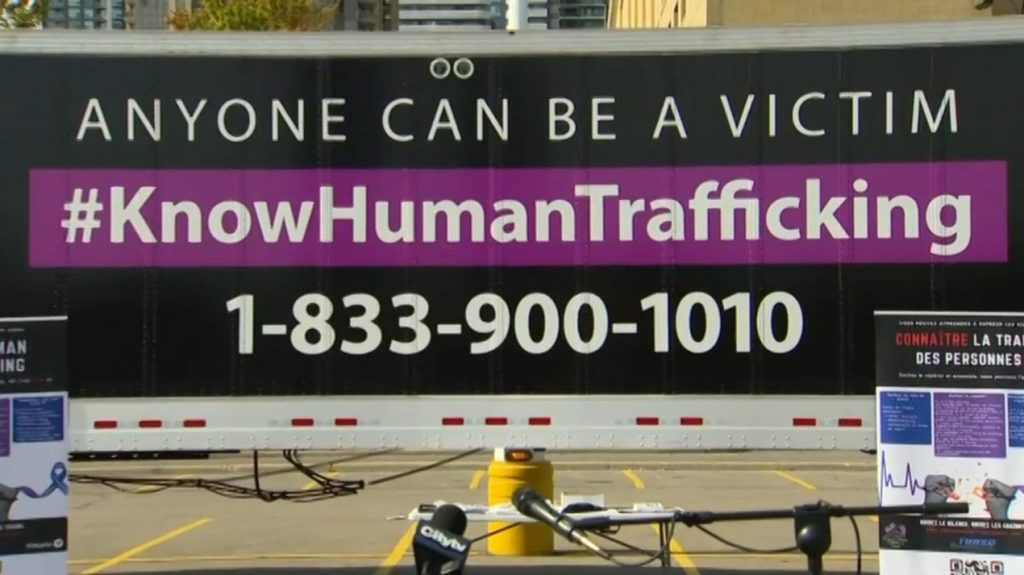
Identifying root causes key to fighting human trafficking
Posted February 17, 2022 4:35 pm.
Last Updated February 17, 2022 5:01 pm.
February is usually a month when we celebrate love, but eight days after Valentine’s Day, attention turns to the prevalence of human trafficking in Canada.
This Feb. 22, the country will mark National Human Trafficking Awareness Day.
Julia Drydyk, Executive Director of the Canadian Centre to End Human Trafficking, said their goal for this year’s awareness day is to start a dialogue on what human trafficking looks like in Canada.
Drydyk said it’s key to understand that the realities of trafficking aren’t properly depicted in the movies where it involves moving people across borders and kidnapping.
“Traffickers position themselves as a boyfriend, a friend, they’ll often love bomb, shower them with expensive gifts and attention, but then use that as a form of collateral control to coerce them into the commercial sex market,” said Drydyk.
Those who are most at risk are people who might be experiencing some sort of vulnerability in their life.
“Where an individual might be in need of housing. They’ll supply a roof over their head. If they’re hungry, they will feed them and if they’re lonely, or if they’re isolated, they will shower them with their hopes, dreams and affection. This quickly turns into a pretty sick form of emotional and psychological abuse,” said Drydyk.
Drydyk said the key is to identify these signs as early as possible, which is hard to do.
Recent research from the Canadian Centre to End Human Trafficking found 93 per cent of Canadians think that human trafficking is an issue, but about three-quarters can’t identify the signs and wouldn’t know what to do if they suspected someone was being trafficked, explained Drydyk.
“Our advice to them is that if your gut feels wrong, it probably is. So trust your instincts, keep lines of communication open.”
Peel Regional Police, whose jurisdiction includes Pearson International Airport, has a dedicated team of 16 officers who investigate human trafficking.
“My officers, every day, are receiving phone calls from members of the community, and they’re engaging the community, whether it’s proactively or reactively regarding human trafficking investigations,” said Det. Sgt. Robert Hackenbrook.
But police say they alone cannot combat human trafficking. “This is not something that we can do by ourselves. We need the cooperation and help of other community partners,” said Sgt. Joy Brown, who works in community mobilization for Peel police.
Police don’t have updated stats on human trafficking but is oftentimes a crime that goes underreported. “I think a lot of people are being told by their trafficker that they’re the ones that are committing the crime. If they report, police are going to arrest them,” explained Sgt. Brown. “There’s also a stigma that comes along with it. There’s also shame as well. And then there’s that psychological control, the manipulation, within the relationship with the trafficker.”
Sgt. Hackenbrook said the police force has done a lot of work to improve how they respond to human trafficking cases.
“We’ve learned from past mistakes and past challenges. For example, communicating better with other organizations. Right now, my officers can pick up the phone and contact any organization in Ontario within a second or the OPP joint forces operation to get assistance because human trafficking is without borders, and it’s very transient,” said Det. Sgt. Hackenbrook.
Peel police have also developed a three-pillar approach to human trafficking that extends beyond policing in partnership with the Region of Peel.
The first and second pillars are prevention and intervention while the third pillar provides support for someone who has been able to escape human trafficking.
“So we have that safe house, you can stay there for up to six months. And then we also have a transitional home where an individual can stay for up to two years and really rebuild their lives,” said Sgt. Brown.
Det. Sgt. Hackenbrook added the victims who do not end up cooperating with police investigations also receive these same supports.
Drydyk told CityNews she doesn’t foresee the impact of human trafficking lessening in the country until all of Canada develops a community-based response to get to the root causes.
“A big part of that is education, awareness and getting at the heart of what these toxic and unhealthy relationships look like. So we need everyone to be coming together from parents, friends, schools, after-school clubs, governments and the private sector to really build a national dialogue,” said Drydyk.
“This is a very sophisticated and underground phenomenon that’s happening in Canada. So if we’re gonna make a difference, we need to be getting at the root of what traffickers are exploiting.”
According to Peel Police, young people in Canada between the ages of 13 to 21 are “extremely vulnerable” to becoming victims of trafficking and traffickers can be men or women.
Here are the common warning signs for human trafficking, according to Peel police:
- Isolation from family and friends.
- More than one cell phone.
- The person is always being monitored or controlled by someone else.
- Stockholm syndrome (protective of the new boyfriend or girlfriend).
- The person is always being moved, usually from hotel to hotel.
- Carrying of condoms or sexual aids.
- Drug use.
- The person does not carry any form of identification with them.
- Visible signs of scarring/tattoos (known as branding).
If you or someone you know may be a victim of human trafficking, you can call the Canadian Human Trafficking Hotline: 1-833-900-1010.