Questions raised about emergency alert, ‘terrorism’ classification after fatal Pickering stabbing
Posted May 30, 2025 3:52 pm.
Last Updated May 30, 2025 6:30 pm.
An emergency alert issued in the Greater Toronto Area hours after a Pickering woman was fatally stabbed is raising questions about the timeliness of the broadcast message as well as how it was classified as “terrorism” on some platforms.
Just after 3 p.m. on Thursday, Durham Regional Police officers said they were called to a home on Lynn Heights Drive, near Whites Road North and Finch Avenue, after receiving reports that a woman was stabbed multiple times. She was later taken to a hospital and pronounced dead.
Durham Regional Police Chief Peter Moreira called the stabbing a “sadistic and cowardly unprovoked attack.”
It wasn’t until 4:49 p.m. that officers posted a generic warning on the service’s X account.
“There is a heavy police presence in the area of Fairport Road and Lynn Heights Drive in Pickering. Police are urging residents to shelter in place,” the post said.
“An adult female has been transported to a Toronto-area trauma centre after being assaulted where she has been pronounced deceased. An unknown suspect remains outstanding. Updates to follow.”
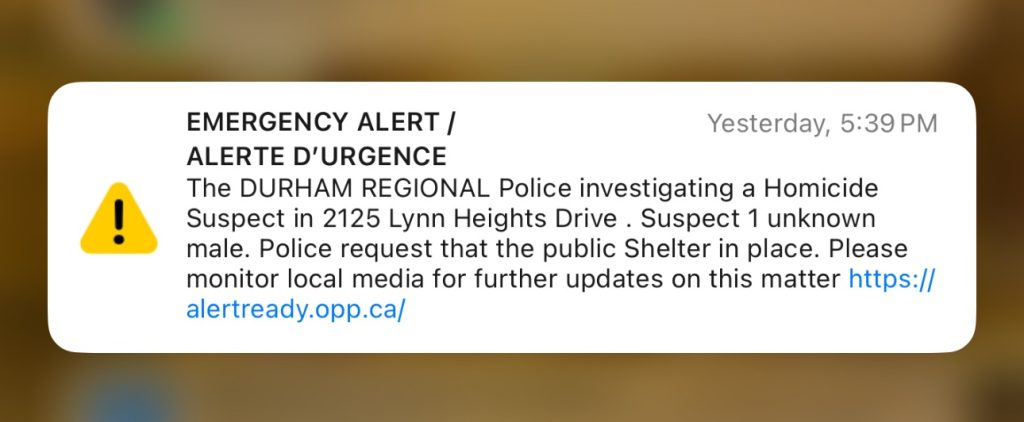
At 5:39 p.m., an emergency alert was broadcast to mobile phones in Pickering as well as other parts of Toronto and Durham Region.
“The Durham Regional Police investigating (sic) a homicide suspect in 2125 Lynn Heights Drive. Suspect 1 unknown male. Police request that the public shelter in place. Please monitor local media for further updates on this matter,” the alert said.
Officers then posted on X that a media update would be held at 7 p.m. Nearly half an hour later, Moreira spoke with reporters and described how officers from multiple services were brought in to assist.
However, when the alert was issued, it showed up on certain sites such as The Weather Network as “terrorism.” Moreira was asked about that classification. He said he was aware of it.
“That certainly wasn’t part of our message, and not the message that we had put out,” Moreira said.
“I’m not sure how that came out to be, but I’ve reviewed what we put out to the OPP.”
CityNews asked about the delay it took for the shelter-in-place warning to reach cellphones.
“There’s a period of time in which we want to make sure that we understand what has happened, so that we can provide accurate information to the community and that we understand fully what it is that we’re asking the community to do on our behalf,” Moreira said.
An hour later, he advised that a teenager had been taken into custody. The accused, a 14-year-old who can’t be identified due to provisions of the Youth Criminal Justice Act, appeared in an Oshawa court Friday morning on a charge of first-degree murder. The allegations against the accused haven’t been proven.
A publication ban imposed by the court also extended to various identifying posts on social media.
The process for issuing alerts in Pickering and elsewhere in Ontario
In Ontario, the Ontario Provincial Police are the only police agency that can process and issue alerts. Local police services must file their requests for alerts through the OPP. It’s up to the OPP to produce the content of the alert, to select if it’s sent as a text and/or audio message, to select the geographic area it’s going to, and to consider a potential cancellation.
The OPP verifies the information submitted, and the alert is sent to broadcast distributors through the National Alert Aggregation and Dissemination (NAAD) service, a key component of Canada’s national emergency alerting system known as Alert Ready.
The NAAD, after receiving the request from OPP, is responsible for checking to ensure it meets the correct formatting and technical requirements before pushing it to the broadcast distributors.
The broadcast distributors (wireless, television, radio and cable and satellite operators) must relay that information through each of the mediums the companies operate.
Pelmorex, which operates The Weather Network and other entities, is responsible for Canada’s national alert infrastructure.
CityNews contacted the company to ask about why it showed up as “terrorism” on certain outlets, even though on phones it said “emergency alert.”
Spokesperson Martin Belanger said when the message came in from OPP, there was some sort of box or indication it might have been terrorism.
“Alert distributors display the content that is provided in the alert. In this case, the alert type was terrorism, which was what was received from the OPP, so that was not something that The Weather Network decided,” he explained.
“As to why they chose this specific type of alert, that’s best answered by the Ontario Provincial Police.”
He added there is the capability to issue cellphone alerts to specific transmission towers to ensure a more localized targeting of messages, but added a decision on where the alert goes falls to the OPP.
CityNews contacted the OPP’s headquarters to ask about the distribution of the alerts in Pickering and beyond.
“The timeline of yesterday’s alert accounts for the necessity of an investigation by the police service of jurisdiction, meeting and confirming all criteria as well as submission of the alerting request to the OPP,” acting Staff-Sgt. Jeffrey Del Guidice told CityNews Friday evening.
“Once the OPP received the request for an alert, it took less than 20 minutes to issue. During this time period, the OPP is required to review and translate the request before it is issued.”
He said the alert classification as “terrorism” has been deemed a “technical malfunction.”
“Once this error was recognized, the OPP corrected the information. We are currently investigating the cause of this malfunction and are working on a resolution.”
How effective are emergency alerts?
Jack Rozdilsky, an associate professor of disaster and emergency management at York University, said emergency alerts of this nature are intended to get public messages out rapidly and efficiently.
“Emergency alerts save lives in terms of enhancing preparedness, and the Canada Alert Ready system is a primary system that’s used within all provinces and territories of Canada to send effective mass alerts to populations in advance of events or during active disaster events so that the population can take proper protective measures,” he told CityNews.
“For a majority of the time, emergency alerts result in a successful conclusion when they serve the purpose as intended.”
Rozdilsky noted that in 2024, the system was used 236 times. A majority of those alerts related to severe weather warnings, and only four of those messages came from law enforcement and were tied to civil emergencies.
He said he largely agreed with how the alert was issued in response to the incident in Pickering.
“Given the dynamic situation, details of which are emerging, authorities made a call which I think was a wise judgment call,” Rozdilsky said.
However, he said a review should be done to look at the “interconnected systems and how the four-step process of the alert works, specifically understanding as much as we can about interactions between the government agency which issues the alert and how that alert is inputted into the system.”
With files from John Marchesan