Canada’s Quinn becomes 1st openly transgender athlete to win Olympic gold medal

Posted August 6, 2021 12:04 pm.
Last Updated August 6, 2021 3:52 pm.
EDMONTON – The Canadian women’s soccer team is making strides in the sports community in more ways than one.
A member of Canada’s team is now the first openly transgender and non-binary athlete to win an Olympic medal – and it’s gold to boot.
READ MORE: Canada wins gold medal in women’s soccer against Sweden in penalty kicks
Midfielder Quinn, 25, publicly came out in a social media post last fall.
“I feel sad knowing there were Olympians before me unable to live their truth because of the world,” Quinn said in July.
“I feel optimistic for change. Change in legislature. Changes in rules, structures, and mindsets. Mostly, I feel aware of the realities. Trans girls being banned from sports. Trans women facing discrimination and bias while trying to pursue their Olympic dreams.”
“Coming out is HARD (and kinda bs),” Quinn added. “I know for me it’s something I’ll be doing over again for the rest of my life. As I’ve lived as an openly trans person with the people I love most for many years, I did always wonder when I’d come out publicly.”
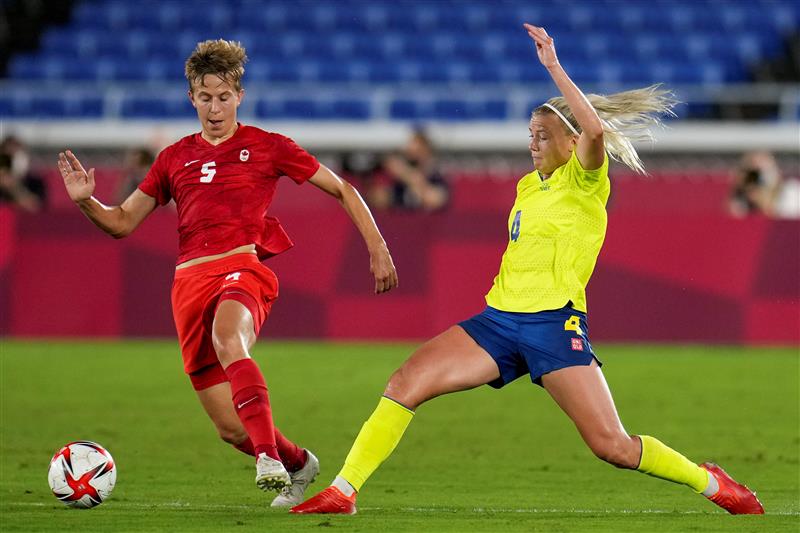
Canada’s Quinn, left, and Sweden’s Hanna Glas battle for the ball in the women’s soccer match for the gold medal at the 2020 Summer Olympics, Friday, Aug. 6, 2021, in Yokohama, Japan. (AP Photo/Fernando Vergara)
A 25-year-old midfielder from Toronto, Quinn played soccer at Duke University and now plays for Washington’s OL Reign in the NWSL.
Since their debut with Canada in 2014, Quinn has now appeared in 69 games for Canada, including being part of the bronze-medal winning in Rio in 2016. At the time, they had not publicly said they were transgender.
MacEwan University’s Dr. Kristopher Wells says this is a pivotal moment for the LGBTQ+ community.
“Seeing our very first trans, non-binary athlete receive a medal, and the gold medal at that, is hugely important,” said the Canada Research Chair for the Public Understanding of Sexual and Gender Minority Youth.
“Having representation on an international platform in an environment like sports that is not welcoming or supportive of LGBTQ athletes is huge and it can’t be understated enough the importance of this accomplishment.”
RELATED: Calgary soccer fans thrilled with CanWNT gold medal win
Wells says having Quinn on the podium will surely inspire kids, especially when LGBTQ+ youth are less likely to compete in sports.
“And this is especially in regard to school-based or team-based sports. And that’s often due to experiences with prejudice and discrimination that start right in the locker room. Or are the result of the inactions of their physical education teachers or the coaches, [by not] interrupting the kind of homophobic, transphobic, and biphobic language that is still very prevalent in many sporting environments,” Wells explained.
“It’s often been said that sports is one of the last tolerated bastions of homophobia and transphobia in our society and I think all the visibility we’ve seen over the last several months is really an important sign of the change that’s happening.”
MORE FROM TOKYO: Daily Recap: Canada’s results at the Olympics
Wells also says that Quinn has been a perfect ambassador for the community, and their gender-neutral they/them pronouns are providing the broadcast community and the world an educational opportunity.
“[Quinn] has real pride in their identity, the strength of their character, and is not afraid to correct people when the language they use is not correct or is inappropriate. So I think this is really an opportunity for us to normalize the use of pronouns to understand how important they are, and you know exactly what it means.”
– with files from Claire Fenton and Sportsnet