Ontario MPPs getting 35% raise after 16-year freeze, new pension plan
Posted May 29, 2025 1:07 pm.
Last Updated May 30, 2025 9:09 am.
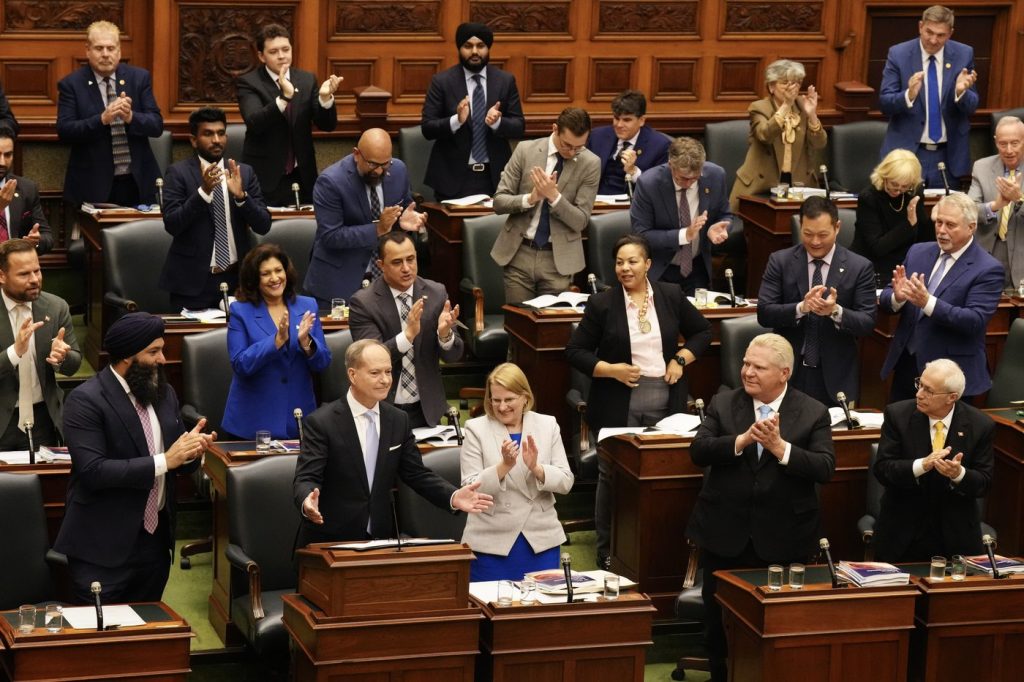
The Ford government has moved to give all Ontario MPPs a 35-per-cent raise after a 16-year freeze as well as changing how provincial politicians receive their pensions, marking an uncommon spirit of agreement among all representatives.
Finance Minister Peter Bethlenfalvy tabled legislation at Queen’s Park on Thursday to end a cap on salary raises that was initially put in place in 2009 under the previous Liberal government led by former premier Dalton McGuinty, bringing provincial representatives closer to what federal MPs earn. MPPs from all parties backed the measure minutes after it was introduced.
“I know many people across the province work tirelessly to put food on the table and pay the rent. We think this is the right thing to do. It’s fair and reasonable,” Bethlenfalvy told reporters Thursday afternoon when asked about the move compared to what Ontario residents earn.
“Well, if not now, when? As my colleagues have said, 16 years to have zero increase I don’t think is the right thing.
“What we’re doing is putting in place what I believe, and my colleagues believe, is the right thing to do. It’s something that’s very fair in the current environment.”
Currently, an MPP earns $116,550 a year under the Legislative Assembly Act. However, several politicians, depending on their position, receive top-ups. Virtually all Progressive Conservative Party of Ontario MPPs get a top-up above their base salaries since the caucus serves in a qualifying position after being named as a cabinet minister, parliamentary assistant or committee chair.
Under the new legislation, MPPs will earn a base salary of $157,350. Further yearly increases would be tied as a percentage to what federal representatives receive (for example, if MPs get a three-per-cent increase then so would MPPs). The goal of the legislation would involve keeping MPP base salaries at 75 per cent of what an MP earns.
MPs in Canada currently receive a base salary of $209,800 a year and are eligible for a pension after six years of service. Provincial and federal representatives in Ontario roughly represent the same ridings and populations.
Here would be the updated salaries for key roles that include the base salary and the top-up afforded to the position:
- Premier: Current $208,974, new $282,129
- Cabinet minister: Current $165,851, new $223,909
- Associate minister/minister without portfolio: Current $138,928, new $187,561
- Parliamentary assistant: Current $133,217, new $179,851
- Leader of the official opposition (the NDP as of 2025): Current $180,886, new $244,207
- Leader of a recognized party (one with official party status, minimum 12 seats): Current $158,158, new $213,524
- Speaker of the House: Current $152,914, new $208,443
- Chair of a standing or select committee: Current $132,867, new $179,379
Officials said the measure is expected to cost an extra $6 million in the 2025-2026 fiscal year alone and will be retroactive to Feb. 27, which was the date of the 2025 Ontario election. The costs are expected to increase when there are future salary increases.
The Ford government previously renewed a freeze on salaries when there was an opportunity for raises to increase when there was a surplus.
The pay hike comes at a time when the provincial deficit is projected to hit $14.6 billion in the 2025-2026 fiscal year.
However, officials were quick to highlight that current MPP salaries fall short compared to other representatives. They pointed to the current salaries of the prime minister ($419,600), the mayor of Toronto ($225,304), the mayor of Brampton ($217,398), the mayor of Vaughan ($209,703), a councillor in Toronto ($170,558), a councillor in Brampton ($161,152) and a councillor in Mississauga ($159,684) as examples where the pay above what is proposed for an Ontario MPP base salary.
Provincial representatives in Quebec voted in 2023 to increase their annual base salary to $131,766 from $101,561.
When it comes to MPP pensions, the legislation created a new, mandatory defined benefit plan model.
MPPs will join the current Ontario Public Service Pension Plan (PSPP) on Jan. 1, 2026. To qualify for the new pension, MPPs need to serve until the current parliament dissolves for the next general election.
They will be required to enrol in the PSPP and contribute to receive a base benefit. There would be a top-up for those who served at least six years. Their pensions would be based on the three-year best average salary and an accrual rate of three per cent per year of their salary.
There would be two tiers of pension retirement eligibility: Full pension when retiring at 65 years of age, or early retirement at 55 years of age (which would be reduced to an accrual rate of two per cent per year and an overall pension reduction of 20 per cent).
For MPPs who are between 65 and 71, participation will be optional. People 71 and older will qualify for an allowance while federal rules prohibit those in the same age bracket from accruing pension benefits.
An example cited by officials of what a pension will look like under the new plan involved a 49-year-old MPP who had six years of service and only earned a base salary. If they claimed their pension starting at 65 years of age, their initial annual payout will be $33,425. If they took an early retirement between 55 and 64 with the 20-per-cent reduction, their initial annual payout will be $24,530. The base figure increases by a small percentage for each additional year of service.
If an MPP earning a base salary alone doesn’t reach six years, they will receive $17,070 a year after turning 65 or $8,353 if they claimed an early retirement pension between 55 and 64 years of age.
The proposed changes to pensions don’t apply to existing retired MPPs.
It’s expected to cost $2.4 million starting in 2026 for the PSPP and another $4.4 million annually for the supplemental MPP benefit. The costs are expected to increase when there are future salary increases.
Bethlenfalvy added he “values public service” and the pay increase honours that sentiment, emphasizing the role of an MPP is a “24-7” job.
“MPPs are people too. They have to pay groceries, they have to pay rent, time away from their families, and, again, this is for public servants.”
Ontario NDP House leader John Vanthof thanked Ford and the government for “having the guts” to move ahead with the measure.
“What makes this generational is I’m getting up there in years. When we’re looking for other candidates, qualified people, to actually direct the future of this province, for most of them they have to take a huge pay cut to come here and give up in many cases pensions,” he said.
“We’re not going to build the future of this province by excluding the people who have the qualifications and have the knowledge to move us forward, so we’re fully in support.”
Ontario Liberal Party House leader John Fraser also praised the Progressive Conservatives along with other opposition parties.
“The pay freeze, it’s been around for a generation … it’s actually about the generations that are going to come after us as well too … we will make sure that we have the best and the brightest come here, and want to be able to come here and not be disincentivized.”
Green Party of Ontario deputy leader Aislinn Clancy and independent MPP Bobbi Ann Brady both echoed the comments, adding the 16-year freeze was too long.