Ontario to pause reopening plan, won’t lift capacity limits in some settings next week
Posted November 10, 2021 3:08 pm.
Last Updated November 10, 2021 5:52 pm.
Ontario is pausing its plan to lift capacity limits in high-risk settings where proof of vaccination is required “out of an abundance of caution” as the province sees a recent spike in COVID-19 infections.
The province intended on removing a cap on the number of people permitted in nightclubs, strip clubs, sex clubs and bathhouses next Monday, on November 15.
The province says that while some positive indicators remain in the fight against the pandemic, such as stabilized intensive care capacity, specific public health trends — including the effective reproduction number and percent positivity — have increased slightly over the past week.
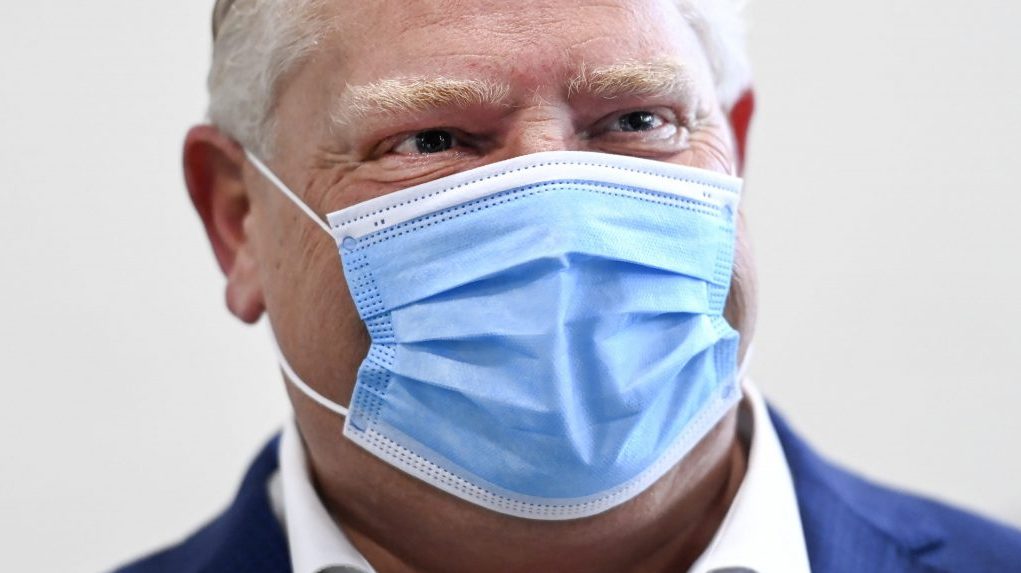
Dr. Kieran Moore, Ontario’s Chief Medical Officer of Health, says existing capacity limits and physical distancing requirements for higher-risk settings where proof of vaccination is required will stay in place. These include food or drink establishments with dance facilities — such as nightclubs and wedding receptions in meeting/event spaces where there is dancing — strip clubs, sex clubs and bathhouses.
“While Ontario has continued to make progress as a result of its safe and cautious approach to reopening, it is necessary to make this deliberate pause as we approach the winter holidays where more people will begin gathering indoors and where students will be returning to in-class learning in January after celebrating with friends and family,” Moore said.
RELATED:
-
Capacity limits for restaurants, gyms to lift Monday as part of 6-month reopening plan
-
COVID-19 infections rising again in Ontario. Why experts say there’s no need to panic
“Over the coming weeks and months, we need to stay the course on reaching those who have not yet been vaccinated, follow public health and workplace safety measures, and continue to remain vigilant in order to minimize the transmission of COVID-19 and keep our communities safe.”
Moore had predicted a rise in cases as fall set in and said that so long as everyone keeps public health measures in mind, there’s no need for alarm.
“I am happy at present with the trends that we have, limiting the effect on our health-care system, but we have to maintain those for the coming weeks and months,” he said.
Moore affirms the province will monitor data for the next 28 days to determine when it is safe to lift capacity limits in these settings. The province announced in late Oct. that barring any major setbacks, it intends to lift all public health and workplace safety measures by March 28, 2022.
Ontario reported 454 new COVID-19 cases on Wednesday as the seven-day average of cases continues to rise, now sitting at 503 cases, reaching the highest point in nearly a month.
The effective reproduction number, or R(t), that Moore mentioned — which corresponds to the average number of additional infections caused by 1 infection — has risen in the last month or so. Provincial data shows that Ontario’s R(t) has gone up from 0.94 throughout the week of Oct. 2 to Oct. 8, now at 1.04. Ontario’s Science Advisory Table says an R(t) of greater than 1 indicates exponential growth.
The head of Ontario’s Science Advisory Table said Tuesday that rolling back some of the recent verdicts on capacity limits and reconsidering behaviour could be all it takes to change the trajectory and once again achieve a stable case count.
“This may be more of a local decision depending on where you are in the province,” Dr. Peter Juni. “The province needs to keep an open mind and we need to be ready to have a difficult discussion on a province-wide level.”
Health officials in Sudbury announced Monday they would be reintroducing capacity limits, require masking at organized public events and require proof of vaccination for youth sports amid a “record number” of virus outbreaks and an “alarming” surge that isn’t tied to any particular setting.
Mayor John Tory was asked Tuesday if Toronto has any plans to reintroduce capacity limits — while he didn’t speak about specific plans he says officials continue to monitor the numbers.
“As these kinds of things change and as we continue to adjust through large sporting events, through increased capacity that was brought in for restaurants, we’re constantly monitoring these numbers on a daily basis.”
Dr. Juni said the trend marks the end of a plateau in infections that came after an earlier bump in July — the beginning of the fourth wave — when the province’s economic reopening accelerated and people began interacting in higher numbers.
Millions of more Ontarians got vaccinated against the virus over the summer, Juni said, and people’s behaviour stayed at a constant level, leading to a drop in infections in the fall.
But things started to shift in mid-October when the province began lifting capacity limits on sporting venues and later restaurants. Then the weather began to cool off, driving gatherings indoors. People might have also started to take fewer precautions in light of those changes and high vaccination coverage in the province, he said.
More than 85 per cent of residents 12 and older have received two COVID-19 vaccine doses.
With files from The Canadian Press